Showing posts with label wealth. Show all posts

Tuesday, September 30, 2014

SYSTEMS MATTER Part 11: Profits and Losses

Founder, Project C.U.R.E.
Author, The Happiest Man in the World: Life Lessons from a Cultural Economist


Repeatedly we have asked why some countries are poor and other countries are rich. Our discussions keep bringing us to the conclusion that the countries that are wealthy, or becoming wealthy, are those that are capable of producing higher levels of income. Those higher levels of income are generated from successful production of goods and services based on the effective use of the country’s natural resources.

In order to make the best and most productive use of the natural resources in a country, the individuals within that country must experience cultural and economic freedom. They must be free to pursue their own interests and be allowed to make choices that they personally determine will result in their ending up better off. When those freedoms exist, the individuals are allowed to generate higher incomes by creating new wealth to be enjoyed by themselves and their country. To the degree that those freedoms are denied or restricted, the country will be less wealthy.

It is good to remember that profits are absolutely necessary to the existence of enterprises. Not very many people would run the risks of ever establishing a business without the possibility of making a profit. Without businesses, we wouldn’t have the goods and services we enjoy and to which we have become so accustomed. But let’s take a deeper look at the function of profit.
  • Profit: The phenomenon of profit is the indicator of growth. It is the mechanism that sends the message that growth is being experienced in the economic system. Profits inform us of the positive value that has been added to the country’s economy, sometimes referred to as the gross domestic product (GDP).
A technology company in the Silicon Valley of California might take a measure of sand and transform it from the recognizable sand granules into a highly desirable and useful computer chip. They may sell the computer chip to another manufacturing company or to an individual. The expense required to transform the sand into a marketable product would be considered their cost. The money received from the purchaser of the computer chip would be their sales price. The difference between the chip manufacturer’s costs and the sales price would be the company’s profit. When the company registers its newly generated profit, it simultaneously records that the wealth of the nation has just increased by the same measure. That wealth represents brand new just- created riches that up until that time had neither existed nor been recorded.
Effectively built into the free enterprise economic model are inherent signals and guidelines that work for increased success and growth. No one specifically designed the model to offer such signals . . . it just functions that way. But those signals and responses all happen so quickly and so silently, even without any individuals or committees in control of the signals. As a result of the simple market forces, individuals are guided to use the nation’s natural resources in the best and most efficient way. That is all possible because the consumers, as well as the business folks, act with the same cultural and economic freedom of choice in the specific areas of  their self-interest. They also believe that their choices will make them better off in the end.
When the consumers buy goods and services, their collective purchases direct resources to businesses that are meeting consumer wants. Their actions also direct resources away from businesses that are not meeting consumer wants. If the consumers purchase enough of a certain product to create a profit for the business, then the business can receive and rely on the signal that it should continue to offer that product for sale.
Adam Smith saw all of those seemingly instant and automatic signals coming out of the existence of the free enterprise economic model, and referred to the anomaly as the invisible hand. That invisible hand utilized all the unintended consequences of all the individuals who were simply acting with cultural and economic freedom of choice while pursuing their own operations of self-interest.

Even high profits send an important signal and serve a necessary function. High profits attract other players into the industry. As new businesses come in, the competition increases. It is the competition of the new firms that forces prices and profits down, thus increasing the efficiency of the total economy. It is interesting that profits encourage the very competition that keeps profits in check.

The inherent signals coming from the components of prices, profits, losses, and wages, determine not only which industries continue to exist but also which products survive. Only profitable industries, firms, and products survive. That also makes for a more efficient economy.
  • Losses: The concept of losses plays an equally important role in sending signals to the economic marketplace. Businesses must match their production choices with the consumer choices or face losses and eventual bankruptcy. In the system, profits seem to be the rewards and losses seem to be the pain. But in the long haul, even the pain of the losses serves to bring about rewards. Losses send the signal that something must change because the natural resources are not being used for the highest and most efficient means.
Just as high profits in a certain industry will send signals for new businesses to get involved in the same activity, so also do losses send a strong signal for others to pack up and get out. Those negative signals are strong and equally important.

When a business incurs costs that exceed profits, it is in trouble. It is time for it to change its approach and use its resources some other way. That is a hard lesson to learn. But failure in a business simply means that the business is not making other people better off. When that failure occurs, the resources that the business was using can now be used for other purposes. Other managers can now have a go at managing those resources. It is hoped that they will be successful in making people better off, and, as a result, make a profit from redirecting those resources.
 It is important that we ask why some countries are wealthy and others are not. It is likewise important to ask why some countries were wealthy and are presently becoming less wealthy. It is important to investigate at what level the individuals of a country are presently experiencing cultural and economic freedom as they access a country’s natural resources. It is still important to observe if the individuals are allowed to generate higher incomes by creating new wealth to be enjoyed by themselves and their countries.

Let’s keep observing and asking questions. Let’s keep discovering!

Next Week: Wages

          (Research ideas from Dr. Jackson’s new writing project on Cultural Economics)

© Dr. James W. Jackson   
Permissions granted by Winston-Crown Publishing House
www.drjameswjackson.com   


Dr. James W. Jackson often describes himself as "The Happiest Man in the World." A successful businessman, award-winning author and humanitarian, Jackson is also a renowned Cultural Economist and international consultant, helping organizations and governments to apply sound economic principals to the transformation of culture so that everyone is "better off."

As the founder of Project C.U.R.E., Dr. Jackson traveled to more than one hundred fifty countries assessing healthcare facilities, meeting with government leaders and "delivering health and hope" in the form of medical supplies and equipment to the world's most needy people. Literally thousands of people are alive today as a direct result of the tireless efforts of Project C.U.R.E.'s staff, volunteers and Dr. Jackson. 

To contact Dr. Jackson, or to book him for an interview or speaking engagement: press@winstoncrown.com

Tuesday, August 6, 2013

SO, WHAT IS MONEY?

Founder, Project C.U.R.E.
Author, The Happiest Man in the World: Life Lessons from a Cultural Economist


Has there always been money? Where does it come from? Who determines its value? Are credit cards really money? Does the value of money always shrink with age? What happens when money fails to maintain its power to purchase? What would a totally cashless society look like?

In 1758, philosopher/economist David Hume stated:
          Money is not, properly speaking, one of the subjects of commerce, but only the                  instrument which men have agreed upon to facilitate the exchange of one                            commodity for another. It is none of the wheels of trade: It is the oil which                     renders the motions of the wheels more smooth and easy.

We have come a long way since David Hume’s discussions regarding money in the eighteenth century. In my travels I have observed different cultures using some pretty strange things as money: salt, animal hides, wives, cattle, wheat, and beads.

By the way . . . how is your confidence level these days in having all your store of wealth represented by numbers in your bank’s computer?

        (Research ideas from Dr. Jackson’s new writing project on Cultural Economics) 


Dr. James W. Jackson often describes himself as "The Happiest Man in the World." A successful businessman, award-winning author and humanitarian, Jackson is also a renowned Cultural Economist and international consultant, helping organizations and governments to apply sound economic principals to the transformation of culture so that everyone is "better off."

As the founder of Project C.U.R.E., Dr. Jackson traveled to more than one hundred fifty countries assessing healthcare facilities, meeting with government leaders and "delivering health and hope" in the form of medical supplies and equipment to the world's most needy people. Literally thousands of people are alive today as a direct result of the tireless efforts of Project C.U.R.E.'s staff, volunteers and Dr. Jackson. 

To contact Dr. Jackson, or to book him for an interview or speaking engagement: press@winstoncrown.com
Tuesday, July 30, 2013

PRODUCTION OF GOODS AND SERVICES


Founder, Project C.U.R.E.
Author, The Happiest Man in the World: Life Lessons from a Cultural Economist


In order for a country to experience a functional economy, it must produce goods and services. Through that production income is created.

If the country does not successfully utilize its natural resources and encourage its human resources to produce, it will be poor. Production that results in income is mandatory.

In order to break the cycle of poverty in a developing country, income must be produced. Income can only be created when resources are efficiently used to produce the desired goods and services needed within that country, or can be traded in a broader market to meet the needs of another group of people.

Countries like Vietnam, Cambodia, and China, who now are beginning to understand and encourage that concept, are increasing their wealth.

Those countries that do not encourage or allow such practices, like Zimbabwe, Mauritania, and Cuba, remain in poverty.

        (Research ideas from Dr. Jackson’s new writing project on Cultural Economics)

 
Dr. James W. Jackson often describes himself as "The Happiest Man in the World." A successful businessman, award-winning author and humanitarian, Jackson is also a renowned Cultural Economist and international consultant, helping organizations and governments to apply sound economic principals to the transformation of culture so that everyone is "better off."

As the founder of Project C.U.R.E., Dr. Jackson traveled to more than one hundred fifty countries assessing healthcare facilities, meeting with government leaders and "delivering health and hope" in the form of medical supplies and equipment to the world's most needy people. Literally thousands of people are alive today as a direct result of the tireless efforts of Project C.U.R.E.'s staff, volunteers and Dr. Jackson. 

To contact Dr. Jackson, or to book him for an interview or speaking engagement: press@winstoncrown.com

Tuesday, March 26, 2013

STATUS SYMBOLS

Founder, Project C.U.R.E.
Author, The Happiest Man in the World: Life Lessons from a Cultural Economist


On the border of Ukraine and Romania, near the town of Gura Humorului, surrounded by orchards of peach, cherry, apple, and pear trees, is a large community of artistic “tinners.” While visiting the area, I discovered that the Ukrainian, Russian, and Romanian metal workers of that area historically possessed unique abilities to design and build ornate roofs of crafted sheet metal. Their homes, barns, gazebos, and even outhouses displayed roofs of stunning architecture and art form. The beautiful buildings were definitely influenced by the architecture of the old Orthodox churches, and each building delivered a pronounced message of the owner’s belief and support of the old Orthodox Christian institutions. They were eminent statements of status.

Several months later, I was traveling through the West African country of Cameroon. About 5:30 Saturday morning, I was able to negotiate for a small loaf of French bread, butter, and a cup of hot tea. My driver, Vincent, had been up early and had the Toyota SUV washed and filled with diesel for our eight-hour trip from the seaport city of Douala, north to the Mbingo hospital close to the border of Nigeria.

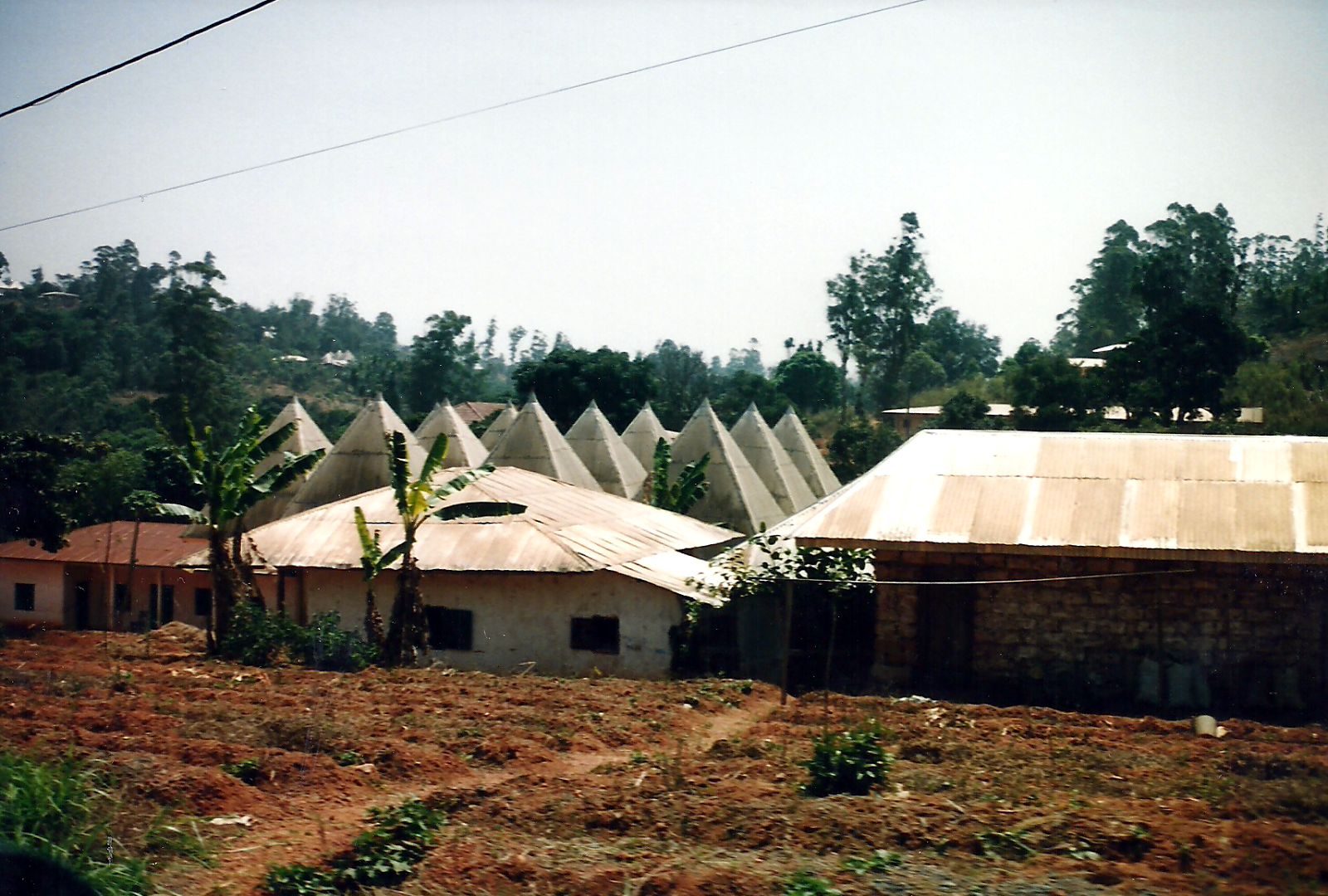
We took the seaport route out of Douala, a bustling city of two and a half million people, and successfully dodged pot holes and unpredictable Saturday morning market traffic. We made our way through sleepy African towns of Limbe, N’Kongsamba, and Kunba. As we approached the city of Bafoussam, I noticed certain houses that had high-pitched metal roofs made of shiny sheet metal, usually with a design similar to a weather vane on top. Some compounds had several of the peaked roofs, and others had, maybe, only one or two, and some had no peaked metal roofs at all.


I was aware of the Muslim influence in that part of West Africa, and asked Vincent if the steep square roofs of metal had anything to do with Muslim culture?

“No,” replied Vincent, “in this western region of Cameroon the culture only allows you to place one of those steep metal roofs on your buildings if you have reached a certain level of wealth. They are symbolic of castles or royalty. You must pass the wealth test, and then the other wealthy people of the area give you permission to build a steep roof. The more wealth you have the more steep roofs you are allowed to build. That is why some compounds have six or eight roofs and others only have one, and some have none. It is necessary for the real rich to constantly keep building outbuildings just to display more roofs as a status symbol of wealth.

As we entered Bafoussam, I asked Vincent what he meant by wealth. “How wealthy are the people of Bafoussam in comparative value?”

“The people of Bafoussam are everywhere in Cameroon, but their real homes are in this western region of the country.” He went on, “about all the buildings in Douala, and the capital city of Younde, are owned by the people of Bafoussam. Nearly all the construction companies are owned by them. They pretty much control the wealth of the country, and these peaked roofs send out that message.”

A status symbol is a visible, external message of one's perceived social or economic position.

What people employ as status symbols will differ between countries and cultures based on what is considered valuable to them. It is not unusual that status symbols even change over time. Anna Marie and I love to visit the historic homes and castles throughout the world. Before the invention of the printing press, owning a large collection of books was considered an impressive status symbol. With time, books became a less-recognized or rarefied status symbol.

Possessions typically perceived as status symbols in our culture may include a large house or penthouse apartment, a second home or ski chalet, haute couture fashionable clothes, some number of luxury vehicles, a trophy wife, a sizable collection of high-priced artworks or antiques, a privately owned aircraft or a luxury boat that is moveable from one status location to another. Even a securely tenured position at a prestigious university or research institute can be flaunted as a mark of high status.

Ancient Central American Mayan cultures artificially induced crosseyedness and flattened the foreheads of high-born infants as a permanent, lifetime sign of noble status. In the Middle East, and especially in the northern tier of African countries, the women use the application of henna on their bodies as status artwork. They like it because it does not wash off, but eventually disappears so that they can start over with new designs. However, they are some of the first persons to come to our free health clinics complaining of permanent liver problems. The blood that carries the henna designs away from the skin deposits the dye in the liver. That can be fatal.

The employment of status symbols can be a very tricky activity, indeed. Many times an individual is capable of buying the status symbol solely to impress others, but does not possess the personal wealth that is implied by the symbol. Charles Spurgeon, the theologian of another era, warned the people of his day, “No one is so miserable as the poor person who maintains the appearance of wealth.” Robert Frank penned an article in the Wall Street Journal regarding our recent financial crisis: “If the financial crisis has a silver lining, it is the decline and fall of the overpriced, over-hyped status economy. You know, the one built on bling and Hummers and Louis Vuitton for the masses. The past decade may have had its excesses, but none was as stupefying as the $300,000 watch that doesn’t tell time.”

Usually, status symbols will give insight into the value system of a culture or subculture. The symbols represent what most people in the culture or society can’t afford to own or indulge in … but wished they could. And, it is but of my own folksy observations, that status symbols wouldn’t even be effective were it not for our human capacities of envy, lust, and discontent. I rather like the advice of ancient Socrates: “If a rich man is proud of his wealth, he should not be praised until it is known how he employs it.”

“Possessions, outward success, publicity, luxury - to me these have always been contemptible. I believe that a simple and unassuming manner of life is best for everyone, best for both the body and the mind.” That quote was Albert Einstein’s view of wealth and symbols of status. I would say that’s some pretty intelligent advice from a pretty intelligent fellow.

Dr. James W. Jackson often describes himself as "The Happiest Man in the World." A successful businessman, award-winning author and humanitarian, Jackson is also a renowned Cultural Economist and international consultant, helping organizations and governments to apply sound economic principals to the transformation of culture so that everyone is "better off."

As the founder of Project C.U.R.E., Dr. Jackson traveled to more than one hundred fifty countries assessing healthcare facilities, meeting with government leaders and "delivering health and hope" in the form of medical supplies and equipment to the world's most needy people. Literally thousands of people are alive today as a direct result of the tireless efforts of Project C.U.R.E.'s staff, volunteers and Dr. Jackson. 

To contact Dr. Jackson, or to book him for an interview or speaking engagement: press@winstoncrown.com