Showing posts with label possessions. Show all posts

Tuesday, January 13, 2015

ECONOMICS OF THE INTERIOR Part 5 An Invitation to Give

Founder, Project C.U.R.E.
Author, The Happiest Man in the World: Life Lessons from a Cultural Economist


Earlier we discussed the fact that everything we possess today was either given to us as a direct gift from God or is in our personal portfolio as the result of a gift exchange. We have traded from the inventory we were first allotted for the acquired possessions we now have. But the basic commodities that we used as trading materials for everything else were given to us.

We did not purchase our time allotment which we now hold as a possession; it was given to us. We did not negotiate for our physical characteristics; we inherited them. We did not bargain on the open market for the basic intellectual capacities; we received them as a gift. We did not ardently go to battle and finally win the power to choose; indeed, that power was given to us. Even the environment in which we move and perform our trading activities came to us as part of our inheritance.

Ultimately, there is only one source of all possessions, one sole proprietor of all that exists whether ordinary or yet to be discovered. That makes for a very interesting economic model. But isn’t it amazing how quickly and how completely we presume that we are totally entitled to all that is in our portfolio? Our daily behavior reveals that we totally own it all without encumbrance.

Then comes the interior economic admonition for us to take that which is in our portfolios and give it to someone who is in need so that he can become better off.
Everything we have has come from you, and we only give you what is yours already! (1Chron. 29:14)
Tell them to use their money to do good. They should be rich in good works and should give happily to those in need, always being ready to share with others whatever God has given them. (1 Timothy 6:18)
Your care for others is the measure of your greatness. (Luke 9:48)
You will be made rich in every way so that you can be generous on every occasion. (2 Corinth. 9:11)
In my research I discovered that the practice of selfless giving to the needs of others was not just a suggestion, but an integral characteristic of the economics of the interior model. The expectation to give generously, however, was accompanied by a residual benefit:that which you gave away would be replaced with even more, in the form of a heavenly compensating deposit from God’s economy, so that you could duplicate the experience again and again.
For God, who gives seed to the farmer to plant, and later on good crops to harvest and eat, will give you more and more seed to plant, and will make it grow so that you can give away more and more fruit from your harvest. (2 Corinth. 9:10)
Now it is required that those who have been given a trust must prove faithful. (1 Corinth. 4:2)
For the man who uses well what he is given shall be given more, and he shall have abundance. (Matt. 25:29)
Give and it will be given to you. A good measure, pressed down, shaken together and running over, will be poured into your lap. (Luke 6:38)
During my reading assignment of the Holy Scriptures I became abruptly aware of why it is necessary to label it God’s economy. There would be no other way in all the earth to keep track of how all this was to work out. For example, if we were to respond in obedience and give away out of our earthly portfolios to some situation of need, how would we, or anyone else, ever know what would be needed to be deposited back into our account as a compensation? I learned that the things that are deposited back into our portfolios are exactly the things needed for our next episode of giving out. The compensation is determined by the next situations of need. God determines the amount, kind, and timing of the compensating deposits. We are responsible only for the current inventory in our portfolio.

In the early 1970s, when Anna Marie and I decided to give our wealth away and start over on the economic model of the interior, we gave away what would in today’s values be worth approximately one hundred million dollars. Did God deposit back into our portfolio prime real estate, financial instruments, and cash? No, he was much wiser and more creative. He did, however, deposit into our portfolio the concept and inspiration for an entity of goodness called Project C.U.R.E. that has saved thousands and thousands of lives around the world, and has donated in excess of one billion dollars’ worth of medical goods to needy hospitals and clinics in nearly 150 countries.
If you are really eager to give, then it isn’t important how much you have to give. God wants you to give what you have, not what you haven’t. (2 Corinth 8:12)
Day by day the Lord observes the good deeds done by godly men, and gives them eternal rewards. He cares for them when times are hard; even in famine, they will have enough . . . I have been young and now I am old. And in all my years I have never seen the children of the godly go hungry. Instead, the godly are able to be generous with their gifts and loans to others, and their children are a blessing. (Psalm 37:18-19, 25-26)
It is possible to give away and become richer! It is also possible to hold on too tightly and lose everything. Yes, the generous man shall be rich! By watering others, he waters himself. (Proverbs 11:24-25)
Is it possible, in this model of the economics of the interior, that all the stuff I possess has been given to me and I simply have the power of attorney, along with a fiduciary responsibility, to see to it that I do not hoard that inventory, but utilize it to see that other people in this world end up being better off?
The Lord will give you an abundance of good things in the land, just as he promised: many children, many cattle, and abundant crops. He will open to you his wonderful treasury of rain in the heavens, to give you fine crops every season. He will bless everything you do: and you shall lend to many nations . . . (Deut. 28:11-13)
Those who love and follow me are indeed wealthy. I fill their treasuries. (Proverbs 8:21)
Bring all the tithes into the storehouse so that there will be food enough in my Temple: if you do, I will open up the windows of heaven for you and pour out a blessing so great you won’t have room enough to take it in!
“Try it! Let me prove it to you! Your crops will be large, for I will guard them from insects and plagues. Your grapes won’t shrivel away before they ripen,” says the Lord of Hosts, “and all nations will call you blessed, for you will be a land sparkling with happiness. These are the promises of the Lord of Hosts.” (Malachi 3:10-12)
Tell those who are rich not to be proud and not to trust in their money, which will soon be gone, but their pride and trust should be in the living God who always richly gives us all we need for our enjoyment. Tell them to use their money to do good. They should be rich in good works and should give happily to those in need, always being ready to share with others whatever God has given them. (1 Timothy 6: 17-18)
We have been given a marvelous invitation. The one who has given first and is the sole proprietor of everything that exists has asked us to join him in a life-changing adventure of giving. It is the basis of the economics of the interior model.

In the earlier chapters we agreed that people succeed in a free enterprise system only to the extent that they make other people better off. So it is likewise true when it comes to success regarding the economic system of the interior. You, personally, as well as the entire model, will be successful to the same degree that other people become better off. And we have the opportunity through our management of living and giving to see other people become better off.

Goodness is the created wealth of God’s economy, and we get to be a part of that!

Next Week: You Can’t Manipulate God

(Research ideas from Dr. Jackson’s new writing project on Cultural Economics)

© Dr. James W. Jackson   
Permissions granted by Winston-Crown Publishing House
  
www.drjameswjackson.com 
 
Dr. James W. Jackson often describes himself as "The Happiest Man in the World." A successful businessman, award-winning author and humanitarian, Jackson is also a renowned Cultural Economist and international consultant, helping organizations and governments to apply sound economic principals to the transformation of culture so that everyone is "better off."

As the founder of Project C.U.R.E., Dr. Jackson traveled to more than one hundred fifty countries assessing healthcare facilities, meeting with government leaders and "delivering health and hope" in the form of medical supplies and equipment to the world's most needy people. Literally thousands of people are alive today as a direct result of the tireless efforts of Project C.U.R.E.'s staff, volunteers and Dr. Jackson. 

To contact Dr. Jackson, or to book him for an interview or speaking engagement: press@winstoncrown.com

Tuesday, June 11, 2013

INSATIABLE, PERPETUAL, AND UNIVERSAL

Founder, Project C.U.R.E.
Author, The Happiest Man in the World: Life Lessons from a Cultural Economist


I had been traveling in and out of Cuba since the very early 1990s, and held the first shipping license allowing Project C.U.R.E. to ship donated medical supplies and pieces of medical equipment directly from Miami into Havana. That had been quite an accomplishment, since the borders of the island compound were tightly closed by Fidel Castro, and the U.S. continued a very strict embargo against the Communist regime.

No regularly scheduled flights were allowed between the U.S. and Cuba in those early days because of those economic and political sanctions. The only way to travel into Cuba from the U.S. was by a very unreliable airplane charter service. At the Miami airport the rag-tag ticketing process was absolutely crazy. It took nearly half a day, starting at 4:30 a.m., to negotiate for the tickets and finally board the plane.

When the plane dropped down low enough for the landing procedure, I could see the green countryside surrounding Havana. Everything was so grown over and run down! The runway landing lights were wired on either side of the runway with extension cord wires running on top of the runway. When the planes came across the runway, they had to run over the top of the heavy black extension cords.

By 1999, I was quite comfortable in traveling in and out of Cuba. By then I had discovered a more convenient routine for entering Cuba. My contacts had shown me how to travel to the Casuarinas Hotel on Cable Beach on West Bay Street in Nassau in the Bahamas. At the hotel would be waiting for me an official letter of invitation from Cuba’s minister of health. I would take the invitation letter to the Havanatur’s desk at the Nassau airport, show them my passport and board a prop-driven Aerocaribbean plane to Havana. Upon arriving, I would be met by special VIP services, issued a Cuban visa, and hustled through Cuban immigrations and customs.

On my 1999 trip, I was picked up at the airport by Julian, a Cuban gentleman in his Russian Lada car, and taken to the Hemmingway Marina area of Havana. It was an area of Havana I had never seen before. The marina was surprisingly filled with international sail boats, fancy yachts, and interesting tourists. My hosts had secured a small hotel room for me to stay for two nights near the activity.

Before we went to dinner my hosts introduced me to a fellow from the U.S. who had just sailed his yacht around the world and had dropped anchor in Havana. He invited me on board his breathtaking vessel, and I thought I was once again a little boy on his first trip to a candy store. It had taken the owner twenty-two years to design and build his spectacular blue water yacht. He had commissioned the Royal Huisman Shipyard in Vollenhove, Holland, to create the vessel under the watchful eye of master shipbuilder Wolter Huisman. World renowned co-designers Ron Holland and Pieter Boeldsnijder implemented the inception from what was virtually nothing but a dream into probably the world’s most magnificent piece of floating art and technology.

The magnificent yacht was 145 feet long, its main mast was 160 feet tall (the height of a 16-story building) and it weighed well over a half million pounds. During construction, no corners were cut in the design or creation of the finest and most technical floating vessel of the 20th century. When not under sail, it was propelled by three Mercedes industrial diesel marine engines. The cost of the yacht to the owner was far in excess of 100 million dollars. I asked and found that the owner had acquired his money, in part, by building and selling a very prestigious shoe company.

I tried to express to my new friend my appreciation for his quest for uncompromising excellence. Indeed, it inspired me. He was very curious about Project C.U.R.E., and he invited us to sit down at their dinner table and share with him and his dinner guests about Project C.U.R.E. Before we left, the owner slipped away from the table and invited me to take a complete tour with him below deck. It was a thrill of a lifetime for me. He stopped at one desk and pulled out a 200-page memorial picture and textbook entitled, The Creation of a Masterpiece. Only a few of the books were published. The text and photos documented the entire story of the designing and building of the yacht. I thanked him deeply for the gift and the opportunity to experience his work of art. The book was a very valuable gift to me.

The following night included the sheer joy of returning to the prodigious yacht. The owner had invited us to have some dessert with him. I was sure to take the coffee table picture book back with me for my new friend to autograph. I had stayed up until 1:30 a.m. the night before reading the book and discovered he had chosen anonymity throughout the book, and had requested that he be referred to as “the client” or “the owner.” However, he did include a lovely picture of his 80- year-old mother in the book on the day of the christening.

I asked him about his reason for never having his name mentioned or his photo included. He said, “Jim, people just don’t understand the inconvenience and burden there is attached to being rich … it’s really hard.” We talked about how the things we accumulate always have a way of spinning webs around us until we are nearly totally possessed by the possessions we have accumulated. We mused at how we only add more care and concern to our lives as we add the “stuff” to our lives. “It seems that when we really need to be adding peace and quiet we only attract more anxiety and dissonance to our lives.”

I asked my new friend to please do me the personal favor of at least autographing my personal copy. The following is what he inscribed:

             Jim,
             The greatest joy of living and traveling on the yacht has been the wonderful new                  friends we have made along the way.  Your dedication and work with all the;                        needy of the world is  a real inspiration. For all those whose lives you've                     touched,  a thousand thanks.
             Your friend,

After I had thanked him again for his example to me of excellence, I shared with him about my brother and I having owned the old steam locomotive and train, the “GW 75,” which had been in the different movies with Burt Lancaster, Lee Marvin, and others. He then asked about what business I had been in before Project C.U.R.E. that would include owning an entire steam train.

I went back and told him of how I had decided at an early age that I wanted to be a millionaire by the time I was twenty-five. He interrupted and said he had the same dream to become a millionaire by age thirty-five. I went on to tell him about getting involved in real estate developing, and how I had greatly surpassed my goal of wealth, but discovered that even so, I was not a happy man. Then I told him how God had radically changed my life and I had vowed to give away my wealth, start over again, and never use my talents and abilities to accumulate wealth again for myself.

I confided in him that I believed God had given me a chance to move from success to significance, and Project C.U.R.E. was only a symbol of what had really happened inside me. “I really respect you, my friend, for who you are and what you have accomplished in your life. But at some point, as you are sailing, I wish you would think about the excitement of moving from obvious success to the adventurous phenomenon of significance. There is a difference. I know you are a man of character and would respond to such a concept.”

The two of us hugged each other on the deck of his masterpiece, and I walked down the ladder to where my shoes were and waved goodbye to my new friend.

The old philosopher and economist, David Hume, once said, “This avidity alone, of acquiring goods and possessions for ourselves and our nearest friends, is insatiable, perpetual, and universal.”

It just might be insatiable, perpetual, and universal . . . but it doesn’t necessarily need to be unchangeable.

Dr. James W. Jackson often describes himself as "The Happiest Man in the World." A successful businessman, award-winning author and humanitarian, Jackson is also a renowned Cultural Economist and international consultant, helping organizations and governments to apply sound economic principals to the transformation of culture so that everyone is "better off."

As the founder of Project C.U.R.E., Dr. Jackson traveled to more than one hundred fifty countries assessing healthcare facilities, meeting with government leaders and "delivering health and hope" in the form of medical supplies and equipment to the world's most needy people. Literally thousands of people are alive today as a direct result of the tireless efforts of Project C.U.R.E.'s staff, volunteers and Dr. Jackson. 

To contact Dr. Jackson, or to book him for an interview or speaking engagement: press@winstoncrown.com

Tuesday, March 26, 2013

STATUS SYMBOLS

Founder, Project C.U.R.E.
Author, The Happiest Man in the World: Life Lessons from a Cultural Economist


On the border of Ukraine and Romania, near the town of Gura Humorului, surrounded by orchards of peach, cherry, apple, and pear trees, is a large community of artistic “tinners.” While visiting the area, I discovered that the Ukrainian, Russian, and Romanian metal workers of that area historically possessed unique abilities to design and build ornate roofs of crafted sheet metal. Their homes, barns, gazebos, and even outhouses displayed roofs of stunning architecture and art form. The beautiful buildings were definitely influenced by the architecture of the old Orthodox churches, and each building delivered a pronounced message of the owner’s belief and support of the old Orthodox Christian institutions. They were eminent statements of status.

Several months later, I was traveling through the West African country of Cameroon. About 5:30 Saturday morning, I was able to negotiate for a small loaf of French bread, butter, and a cup of hot tea. My driver, Vincent, had been up early and had the Toyota SUV washed and filled with diesel for our eight-hour trip from the seaport city of Douala, north to the Mbingo hospital close to the border of Nigeria.

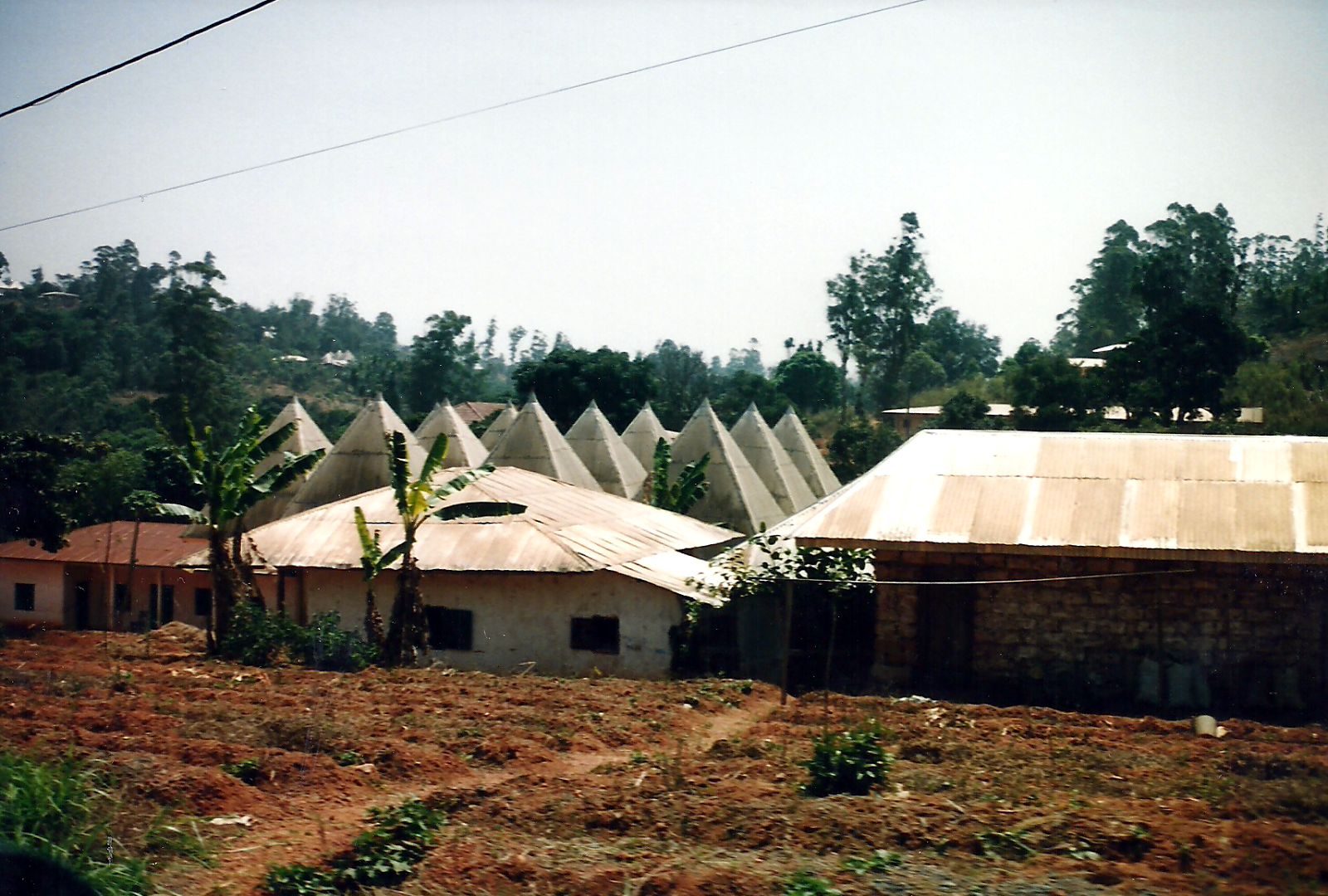
We took the seaport route out of Douala, a bustling city of two and a half million people, and successfully dodged pot holes and unpredictable Saturday morning market traffic. We made our way through sleepy African towns of Limbe, N’Kongsamba, and Kunba. As we approached the city of Bafoussam, I noticed certain houses that had high-pitched metal roofs made of shiny sheet metal, usually with a design similar to a weather vane on top. Some compounds had several of the peaked roofs, and others had, maybe, only one or two, and some had no peaked metal roofs at all.


I was aware of the Muslim influence in that part of West Africa, and asked Vincent if the steep square roofs of metal had anything to do with Muslim culture?

“No,” replied Vincent, “in this western region of Cameroon the culture only allows you to place one of those steep metal roofs on your buildings if you have reached a certain level of wealth. They are symbolic of castles or royalty. You must pass the wealth test, and then the other wealthy people of the area give you permission to build a steep roof. The more wealth you have the more steep roofs you are allowed to build. That is why some compounds have six or eight roofs and others only have one, and some have none. It is necessary for the real rich to constantly keep building outbuildings just to display more roofs as a status symbol of wealth.

As we entered Bafoussam, I asked Vincent what he meant by wealth. “How wealthy are the people of Bafoussam in comparative value?”

“The people of Bafoussam are everywhere in Cameroon, but their real homes are in this western region of the country.” He went on, “about all the buildings in Douala, and the capital city of Younde, are owned by the people of Bafoussam. Nearly all the construction companies are owned by them. They pretty much control the wealth of the country, and these peaked roofs send out that message.”

A status symbol is a visible, external message of one's perceived social or economic position.

What people employ as status symbols will differ between countries and cultures based on what is considered valuable to them. It is not unusual that status symbols even change over time. Anna Marie and I love to visit the historic homes and castles throughout the world. Before the invention of the printing press, owning a large collection of books was considered an impressive status symbol. With time, books became a less-recognized or rarefied status symbol.

Possessions typically perceived as status symbols in our culture may include a large house or penthouse apartment, a second home or ski chalet, haute couture fashionable clothes, some number of luxury vehicles, a trophy wife, a sizable collection of high-priced artworks or antiques, a privately owned aircraft or a luxury boat that is moveable from one status location to another. Even a securely tenured position at a prestigious university or research institute can be flaunted as a mark of high status.

Ancient Central American Mayan cultures artificially induced crosseyedness and flattened the foreheads of high-born infants as a permanent, lifetime sign of noble status. In the Middle East, and especially in the northern tier of African countries, the women use the application of henna on their bodies as status artwork. They like it because it does not wash off, but eventually disappears so that they can start over with new designs. However, they are some of the first persons to come to our free health clinics complaining of permanent liver problems. The blood that carries the henna designs away from the skin deposits the dye in the liver. That can be fatal.

The employment of status symbols can be a very tricky activity, indeed. Many times an individual is capable of buying the status symbol solely to impress others, but does not possess the personal wealth that is implied by the symbol. Charles Spurgeon, the theologian of another era, warned the people of his day, “No one is so miserable as the poor person who maintains the appearance of wealth.” Robert Frank penned an article in the Wall Street Journal regarding our recent financial crisis: “If the financial crisis has a silver lining, it is the decline and fall of the overpriced, over-hyped status economy. You know, the one built on bling and Hummers and Louis Vuitton for the masses. The past decade may have had its excesses, but none was as stupefying as the $300,000 watch that doesn’t tell time.”

Usually, status symbols will give insight into the value system of a culture or subculture. The symbols represent what most people in the culture or society can’t afford to own or indulge in … but wished they could. And, it is but of my own folksy observations, that status symbols wouldn’t even be effective were it not for our human capacities of envy, lust, and discontent. I rather like the advice of ancient Socrates: “If a rich man is proud of his wealth, he should not be praised until it is known how he employs it.”

“Possessions, outward success, publicity, luxury - to me these have always been contemptible. I believe that a simple and unassuming manner of life is best for everyone, best for both the body and the mind.” That quote was Albert Einstein’s view of wealth and symbols of status. I would say that’s some pretty intelligent advice from a pretty intelligent fellow.

Dr. James W. Jackson often describes himself as "The Happiest Man in the World." A successful businessman, award-winning author and humanitarian, Jackson is also a renowned Cultural Economist and international consultant, helping organizations and governments to apply sound economic principals to the transformation of culture so that everyone is "better off."

As the founder of Project C.U.R.E., Dr. Jackson traveled to more than one hundred fifty countries assessing healthcare facilities, meeting with government leaders and "delivering health and hope" in the form of medical supplies and equipment to the world's most needy people. Literally thousands of people are alive today as a direct result of the tireless efforts of Project C.U.R.E.'s staff, volunteers and Dr. Jackson. 

To contact Dr. Jackson, or to book him for an interview or speaking engagement: press@winstoncrown.com