Showing posts with label the happiest man in the world. Show all posts

Tuesday, April 24, 2012

Speechless

Founder, Project C.U.R.E.
Author, The Happiest Man in the World: Life Lessons from a Cultural Economist 


You don’t always have to communicate by talking if you are transparent enough to let people see the love that is in your heart.

One of the most proud and impressive episodes that occurred in Project C.U.R.E.’s history of helping needy hospitals around the world took place in the country of Ukraine. I began traveling to Ukraine shortly after the collapse of the old Soviet Union. By 1996, Project C.U.R.E. was not only helping to change the health care system in Kiev and smaller cities, like Zitomer, but also, in the university city of Vinnitsa. In addition to donating hundreds of thousands of dollars worth of medical goods into the Pirogov Medical University in Vinnitsa, we had also donated and shipped over eighteen tons of medical library books to the university’s library. With that gift they could boast of having the finest English language medical library in all Eastern Europe.


I returned to the old Soviet Union and to Ukraine in September, 1996, with Dr. Mark Johnson and several other wonderful people from Vanderbilt University. It was Dr. Johnson’s first venture away from the sophisticated hospitals of Nashville, Tennessee and the Vanderbilt Medical Community. He was young, but had already gained a great deal of respect in the medical community as an urologist. In addition to the donated medical goods brought to Vinnitsa by Project C.U.R.E., Dr. Johnson spent his own money to purchase urological items that he intended to leave at the university when he returned to the U.S.

Dr. Johnson's mission was to find and train the medical university’s finest urology and obstetrics/gynecology surgeons and professors. He would instruct them in the use of the advanced techniques, and then leave the high‑tech instruments for them. They would be the first in the whole area of the old Soviet Union to be trained in how to use the equipment and perform the procedures.

The targeted university doctors and a few nurses were approached and invited to a meeting at 10:30 the next morning in a consultation room near the operating theaters. A Ukrainian translator agreed to be there to interpret for us. At 10:30 we had all gathered in the room . . . everyone that is except the translator. We quickly burned up the few known Russian and English words of greeting as we introduced ourselves to each other. But, still there was no translator. All were glancing at their watches. These were very busy people.

Then Dr. Johnson did a brilliant thing. He said nothing, but smiled and took the laparoscope and the cystoscope out of their storage cases, along with some containers of capsules, and carefully placed them on the conference table. Next, he took out a black felt pen and some paper and started drawing pictures. The doctors and nurses looked around at each other and smiled at this creative young doctor who wanted to share with them so much that he was not going to let a little thing like a spoken language get in the way of their communicating. The doctors and nurses closed in tightly around Dr. Johnson so they could better see what he was drawing. Now, they were talking the same language, body language.

In the old Soviet Union they were experiencing a lot of problems with gynecological oncology, urinary incontinence, cysts, uterus bleeding, bladder and kidney infections, and also, dysfunctional prostates in males. Up to that time, the only surgical method available was highly invasive surgery. And in Ukraine those procedures were fairly archaic and crude.

As Dr. Johnson proceeded with his art class the physicians began to chatter. Some could not keep their hands off the scopes that were on the table. With the scopes and some pictures, Dr. Johnson began to demonstrate the new concept of minimally invasive diagnostics and surgery. Some of the surgeons had either read a little about the procedures or had seen pictures in medical journals. But this was the first time they had someone explain to them the use of the instruments . . . especially with the unique method of not employing words. They knew well their own problems and recognized quickly the advantages of decreased blood loss, decreased pain, less chance of infection from the surgery, and shorter stays in the hospital.

Dr. Johnson ended up spending most of the day with the university doctors. As you can imagine, by that time they had translators galore! Their delight could hardly be contained when they realized that the new equipment would be left with them for the future. They begged Dr. Johnson to join them in the operating theater the next morning, where they would have him operate on their patients and allow them to further experience the use of the scopes. They even invited him to dinner that evening to celebrate their new friendship.

The next morning we all put on our scrubs and went into the operating theater. Dr. Johnson’s new friends placed on his head the typical tall, Russian stovepipe surgical hat indicating their love and respect for him. Most visitors to their university hospital, who experienced the situation where the translator failed to show up, would have just packed up and headed back to the hotel. But Dr. Johnson’s care and concern for them compelled him to set aside the necessity of communicating with words. He became transparent enough to allow the doctors and nurses to see into his heart and respect him for his willingness to bypass the need to use words.

I wonder, how many times in the past my communications would have been far more effective had I just stopped the flow of words, proceeded with my task, and been transparent enough to let others see the intent of my heart?


Dr. James W. Jackson often describes himself as "The Happiest Man in the World." A successful businessman, award-winning author and humanitarian, Jackson is also a renowned Cultural Economist and international consultant, helping organizations and governments to apply sound economic principals to the transformation of culture so that everyone is "better off."

As the founder of Project C.U.R.E., Dr. Jackson traveled to more than one hundred fifty countries assessing healthcare facilities, meeting with government leaders and "delivering health and hope" in the form of medical supplies and equipment to the world's most needy people. Literally thousands of people are alive today as a direct result of the tireless efforts of Project C.U.R.E.'s staff, volunteers and Dr. Jackson. 


To contact Dr. Jackson, or to book him for an interview or speaking engagement: press@winstoncrown.com

Tuesday, April 17, 2012

Cultural Economics

Founder, Project C.U.R.E.
Author, The Happiest Man in the World: Life Lessons from a Cultural Economist 


Global transformation, national transformation, corporate transformation, and even personal transformation take place at the intersection of Culture and Economics.
(Dr. James W. Jackson,  "THE HAPPIEST MAN IN THE WORLD: Life Lessons from a Cultural Economist”)
I am a Cultural Economist, and I am compelled to make this obvious announcement: People have something to do with economics! There is a temptation to view the study of economics as a complicated and intimidating hodgepodge of charts and graphs used by corporations and governments to manipulate the consumers and persuade the voters. However, the study of economics is a valuable interdisciplinary study, and it is sad to see that so many educational institutions have dropped the teaching of the subject to our students.

Traditional economics concerns itself with the process of how we efficiently allocate and manage our resources of land, labor, capital, and the entrepreneur, and how we choose to organize the production of goods and services. We take our collected data and apply it to chosen charts or matrices so that we can project our conclusions into the future on the basic assumption that future reality will be an extension of past reality. It is easy to visualize the iconic economist with his wire-rimmed glasses observing something taking place in the real world . . . then retreating to his study to research if that which he has observed could actually work in theory.

But, it is good for us to remember that economics is all about people. It is the people with their emotions of love, joy, surprise, anger, sadness, and fear who make up cultures. And it is cultures that affect economics. And, likewise, economics affects cultures. Wherever you find the clashing of culture and economics, you will find the process of transformation taking place. For example:

Global: Observe what is happening in Greece. Rioting is taking place in the streets since May, 2010. The violent protests are over unemployment, inflation, corruption, the national debt crisis, and implementation of austerity measures. In Greece and elsewhere around the world Global Transformation is taking place at the intersection of culture and economics.

National:
A quick comparison of the issues represented within the U.S. by the Occupy Wall Street group and the Tea Party group will reveal the extent of the national transformation presently taking place. Occupy Wall Street is a protest movement employing civil disobedience to support their demands for wealth redistribution through “opposing cutbacks and austerity of any kind,” and eliminating corporate influence of the financial services sector over the government. The Tea Party opposes continued excessive spending and waste, U.S. national debt levels, excessive taxation, and it demands government adherence to the Constitution.

Corporate and Individual: Change at the corporate, and the individual level as well, takes place at the intersection of culture and economics. Wherever the components of the culture, e.g., traditions, institutions, families, and individuals intersect with components of economics, e.g., resources, labor, capital, and the entrepreneur . . . that’s where change takes place.


We all stand at the curbside of that intersection. Each of us participates in the flow of history as it passes through that intersection. At that intersection we actually become the “change agents” of history.

Cultural Economics is the branch of economics that concerns itself with the relationship of culture to economic outcomes. It studies how various aspects of societal cultures interact with economic events, behaviors, and conditions. A given culture will influence our political systems, traditions, religious beliefs, our formation of institutions, and even our value ascribed to individuals. And, conversely, economic philosophies and systems have the power to affect and shape our cultures.

Economics is not a “Dismal Science” as Thomas Carlyle referred to it in his essay written in 1849. It is an exciting adventure when the studies of economics and culture are combined. It can open our eyes to the understanding of motives, methods, behaviors, successes, and failures regarding the stewardship of our world’s resources and human endeavors. Perceptions and persuasions sway even our purchasing patterns. Our economic environment has the flexibility of metamorphosis in reaction to current events and preferences. That makes the study of Cultural Economics an exciting study.


Dr. James W. Jackson often describes himself as "The Happiest Man in the World." A successful businessman, award-winning author and humanitarian, Jackson is also a renowned Cultural Economist and international consultant, helping organizations and governments to apply sound economic principals to the transformation of culture so that everyone is "better off."

As the founder of Project C.U.R.E., Dr. Jackson traveled to more than one hundred fifty countries assessing healthcare facilities, meeting with government leaders and "delivering health and hope" in the form of medical supplies and equipment to the world's most needy people. Literally thousands of people are alive today as a direct result of the tireless efforts of Project C.U.R.E.'s staff, volunteers and Dr. Jackson. 


To contact Dr. Jackson, or to book him for an interview or speaking engagement: press@winstoncrown.com

Tuesday, April 10, 2012

Poverty

Founder, Project C.U.R.E.
Author, The Happiest Man in the World: Life Lessons from a Cultural Economist
"It is a shameful day, indeed, when we discover that by our own, or our government's behavior, we have contributed to keeping people in the bondage of poverty."
Poverty is a tragically slippery word. It can be massaged and bent around to validate almost any point you would like to make, e.g. “If we would just stop practicing poverty we would not have any poor people,” or Martin Fisher’s ill-advised comment, “The great doctors all got their education off dirt pavements and poverty – not marble floors and foundations,” or H. Rapp

Brown’s famous quote, “You see, the poverty programs for the last 5 years have been buy-off programs.”

The English word poverty came from the Anglo-Norman povert, and originally from the Latin pauper, meaning "poor." It does have something to do with the lack of certain possessions to meet basic human needs. Groups like United Nations and The World Bank try to delineate further with categories of Absolute Poverty and Relative Poverty and varying degrees of standards of living. Book shelves and web-site pages are packed full of theories and opinions as to the origins, descriptions, causes of perpetuation, results, and proposed cures for the phenomenon of poverty.

This essay can’t tackle in 600 or fewer words the entire subjects of wealth and poverty. But I do want to take the space here to report what I have personally seen and experienced over the past thirty-five years since my first involvement in international travel and economic consulting. Specifically, I want to pass on the differences I have observed between the countries that experience relative wealth vs. the countries that experience relative poverty. I have traveled in more than 150 countries, and a large number of the countries I revisited many times. I have had the opportunity to become personal friends with Ministers of Finance, Ministers of Health, Presidents, Prime Ministers and Kings, and have had the privilege to speak at many of the Universities in the developing countries. The topic of economics is a hot subject and evokes instant questions and discussion wherever given a chance.

It has become evident to me that the countries that pursue the following practices are wealthy or are becoming wealthy, while those countries that do not pursue these practices are poor or are becoming poor:
  • Government is willing to allow the people to break the cycle of poverty. As Ronald Reagan once said, “Poverty is a career for lots of well-paid people.” The inevitable consequence of poverty is dependence. As in the case of subsistence farming, it is a great temptation to the leaders of developing countries to allow the people to remain poor and dependent. Ease of governance comes with poor people who spend all their energy and time on daily survival. They are not problematic to the government, but the country remains poor.
  • The people are given the right to hold and freely exchange private property. Private ownership of resources includes the rights of exclusive use and rights of transfer.
  • Individuals are free to agree, free to enter into voluntary agreements and contracts with each other. 
  • The Rule of Law is established and applied equally to all involved. Making agreements and contracts assumes there will be a third party objective resource to enforce the fulfillment of the contracts. Contracts are meaningless if they aren’t enforced.
  • Individuals are free to fail. Everyone in the transaction must be better off or the deal will fail. If the deal is successful, wealth is created. If the deal fails, the individuals must learn why it failed and discover what will make it successful.
  • An understanding that the pursuit of an individual’s best interest is not necessarily greed, i.e., pursuit of self-interest is different than selfishness.
  • Rejection of the zero sum mentality. When one person gets a piece of pie it is not at the expense of another person’s not getting a piece. Successful transactions create wealth. People create successful business transactions. Just because someone creates new wealth does not mean that someone else ends up with less. Wealth creation springs from people who are allowed to freely participate in business transactions.

In order to break the cycle of poverty in a developing country, income must be produced. Income can only be created when resources are used to produce goods and services needed by the people. Countries like Vietnam, Cambodia, and China, who now understand and encourage that concept, are increasing their wealth. Those countries that do not allow such practices, like Zimbabwe, Mauritania, and Cuba, remain in poverty.


Dr. James W. Jackson often describes himself as "The Happiest Man in the World." A successful businessman, award-winning author and humanitarian, Jackson is also a renowned Cultural Economist and international consultant, helping organizations and governments to apply sound economic principals to the transformation of culture so that everyone is "better off."

As the founder of Project C.U.R.E., Dr. Jackson traveled to more than one hundred fifty countries assessing healthcare facilities, meeting with government leaders and "delivering health and hope" in the form of medical supplies and equipment to the world's most needy people. Literally thousands of people are alive today as a direct result of the tireless efforts of Project C.U.R.E.'s staff, volunteers and Dr. Jackson. 


To contact Dr. Jackson, or to book him for an interview or speaking engagement: press@winstoncrown.com

Tuesday, April 3, 2012

Making Great Out of Little

Founder, Project C.U.R.E.
Author, The Happiest Man in the World: Life Lessons from a Cultural Economist


"Nobody made a greater mistake than he who did nothing because he could only do a little." (Edmond Burke)

Millie was a devoted nurse in the Emergency Room of one of Denver's finest hospitals. She had experienced the raw trauma and stress of fighting to pull helpless victims back from the brink of death. She had also been there to help comfort the anxious and frightened family members who helplessly waited for some indication of hope from the hospital emergency staff.  

Millie's husband, Dave, was a successful physical therapist. He also knew pain, and had spent his career helping hurting humans regain ease and comfort. Their occupations had been satisfying to them over the years because they knew they were helping other people become better off. But the closer they got to retirement age the more excited they got about the future. One day they would be finished with the success of their daily jobs and be free to pursue things they hoped would be of even greater significance. Their list of things to pursue grew longer by the day.


After they retired, Millie and Dave tried several standard post-retirement jobs. None worked out like they had expected. Then, their daughter-in-law suggested they visit Project C.U.R.E. She had volunteered there and understood that with all the international connections and exciting projects going on, surely that would be the place for significant adventure. Besides, it had everything to do with medical involvement, and that would be right down their alley.

Millie first ventured out to Project C.U.R.E. by herself. But the warehouse guy didn't show up for their appointment to show her around. The ethereal dream for significance began to float away with the clouds. But on the second try they connected, and Millie was introduced to Project C.U.R.E. Millie is a bright lady, and the moment she stepped foot inside the warehouse "she got it!" She saw the millions of dollars worth of donated medical goods on the racks ready to be sent out to the needy hospitals around the world. She knew that in the past the hospital where she had worked had discarded vast amounts of medical goods, as were overstocked medical goods of the manufacturers and wholesalers. Here was an organization aggressively recapturing those goods, sorting them, inventorying them, and distributing those goods to hospitals and clinics in every part of the world where they had no current supplies and no adequate pieces of medical equipment . . . even emergency rooms that had nothing at all! Her heart was captured.

The warehouse fellow told her he needed help simplifying the sorting guides to help the many warehouse volunteers more easily sort the thousands of items being inventoried. That's when she recruited husband Dave. Later, they were given the challenge to take the forklifts and rearrange certain areas of the warehouse to make the loading and shipping process easier. Dave and Millie saw that they were needed and that they were making a huge difference in how the entire operation functioned. Very quickly they caught the significance of how each piece of the donated medical goods could make the difference between life and death in some patient on the other side of the world. People would be receiving life- saving goods and would never even know Dave and Millie Truitt, or ever be able to tell them, "thank you."    

Today, Dave and Millie Truitt oversee the staging, loading, and shipping of the huge ocean-going cargo containers headed out to over 125 needy countries of the world. They have faithfully been at their jobs at Project C.U.R.E. for over 12 years. They are full-time, non- paid volunteers who drive over an hour travel time in order to show up and excitedly go to work.

Dave and Millie Truitt are true heroes to me. They did not make the mistake of doing nothing just because they could only do a little. They took what appeared to be just a little job and made it into a great and significant, life changing accomplishment!


Dr. James W. Jackson often describes himself as "The Happiest Man in the World." A successful businessman, award-winning author and humanitarian, Jackson is also a renowned Cultural Economist and international consultant, helping organizations and governments to apply sound economic principals to the transformation of culture so that everyone is "better off."

As the founder of Project C.U.R.E., Dr. Jackson traveled to more than one hundred fifty countries assessing healthcare facilities, meeting with government leaders and "delivering health and hope" in the form of medical supplies and equipment to the world's most needy people. Literally thousands of people are alive today as a direct result of the tireless efforts of Project C.U.R.E.'s staff, volunteers and Dr. Jackson. 


To contact Dr. Jackson, or to book him for an interview or speaking engagement: press@winstoncrown.com

Tuesday, March 27, 2012

Terrorism is the Weed in the Garden of Civilization

Founder, Project C.U.R.E.
Author, The Happiest Man in the World: Life Lessons from a Cultural Economist


Demosthenes gave wise counsel when he admonished, “Beware lest in your anxiety to avoid a war you obtain a master.” Historically, acts of declared war between tribes and nations have left regrettable havoc and loss of life. But, terrorism is different. Its intent is to manipulate and gain psychological advantage through stark fear and the savage and brutal display of destruction. Adolf Hitler proclaimed that, “Terrorism is the best political weapon, for nothing drives people harder than a fear of sudden death.” He later bragged, “Being daily better informed about their knowledge than my adversaries themselves, I argued till finally one day they applied one means that wins the easiest victory over reason: terror and fear.”


Yasser Arafat, one of recent history’s most brutal and vicious terrorists, recruited and mentored Osama Bin Laden and convinced him that terrorism works successfully, and that terrorists can be praised and rewarded by a craven world. Terrorism doesn’t require a large and expensive army. It takes only a few extremists to control the masses by sudden and horrific fear. Terrorism destroys lives of innocent civilians and personal property. It is an on purpose and calculated means of national or religious aggression, and has become a frightening phenomenon of our present global society. The acts are carried out with highly secretive planning and open and shocking execution.

No other method so successfully robs the mind of all its powers of reasoning and acting as does fear. People seem to be willing to give their enemies what they want rather than have to endure the fear of the terrorists brutally taking it away from them. And the terrorists seem to have figured it out that their only limits of terror are prescribed by the endurance of people they terrorize.

Therein lies an interesting fact” acts of terrorism can backfire on the terrorists themselves. Fear is an unpredictable intoxicant. The fumes of fear invade the brain and can actually make men combative rather than compliant. It is dangerous to play the game of terror because the terrorist never can be certain when he goes too far and his hideous acts of terror just might trip the trigger of the oppressed.

I have experienced terrorism up close and personal. My travels into Somalia, Albania, Kosovo, Serbia, Yugoslavia, Rwanda, Uganda, Congo, Lebanon, Gaza, West Bank, North Korea, Cuba, Nagorno Karabakh, Pakistan, Sudan, and even Iraq and Afghanistan have given me a better understanding about the mind of the terrorist. I have concluded that in order to change the fruit you must alter the root. Most of terrorism is fueled by the feelings of hatred based on fear of extinction, extreme despair based on perceptions of gross inequities, and utter hopelessness based on eradication of viable options.

I have come to believe that the most effective deterrent for the phenomenon of terror is a mass infusion of hope. Terrorism is engineered to create fear. But fear is also the necessary element to ignite terrorism. Left unchecked, terror can only escalate because it takes on a life of its own, and one act of terror demands to be answered by another act of terror. Genuine hope dispels fear and short-circuits the need for terror. The whole vicious cycle of fear and terror unravels with the introduction of genuine hope.

The real problem of terrorism comes where the entire garden of civilization is eventually overrun by the weed of terrorism, and in order to rid the garden of the noxious weed the entire garden is destroyed. You simply can’t kill everyone in order to rid the civilization of terrorists. There has to be a more excellent way. I am coming to believe that the answer to the problem of terrorism is kindness, justice, and righteousness on this earth. There is nothing stronger in the world than goodness and gentleness. I am not a dove but a hawk when it comes to protecting my country, family, and home. But, I believe it is time to try channeling our energy and creativity toward winning the hearts and minds of the people of this world.

Project C.U.R.E. is a humanitarian organization specializing in taking help and hope to many countries around the world. It has been involved in some of the most politically explosive “hot spots” in recent years. Project C.U.R.E. has discovered that if you are going to deal with the world of conflict and terrorism you have to plant seeds of hope.

Project C.U.R.E. exists to break down the destructive cycle of hopelessness. We are discovering that dealing with the element of hope is perhaps the most effective method known to strike a blow at the main root of terrorism. The weed of terrorism needs to be eradicated from the Garden of Civilization. The application of the element of hope will go a long way toward that eradication.


Dr. James W. Jackson often describes himself as "The Happiest Man in the World." A successful businessman, award-winning author and humanitarian, Jackson is also a renowned Cultural Economist and international consultant, helping organizations and governments to apply sound economic principals to the transformation of culture so that everyone is "better off."

As the founder of Project C.U.R.E., Dr. Jackson traveled to more than one hundred fifty countries assessing healthcare facilities, meeting with government leaders and "delivering health and hope" in the form of medical supplies and equipment to the world's most needy people. Literally thousands of people are alive today as a direct result of the tireless efforts of Project C.U.R.E.'s staff, volunteers and Dr. Jackson. 


To contact Dr. Jackson, or to book him for an interview or speaking engagement: press@winstoncrown.com

Tuesday, March 20, 2012

Passion - The Road to Success

Founder, Project C.U.R.E.
Author, The Happiest Man in the World: Life Lessons from a Cultural Economist


Put your heart, mind, and soul into even the smallest acts . . . this is the secret of success.

I have a lot of good memories of Central Asia. At one time or another I visited all of the individual republics of the old Soviet Union. Their history is rich and colorful and includes such eccentrics as Genghis Kahn, Timor Tourmaline, Alexander the Great, Joseph Stalin and Khrushchev. Ancient tales of adventures along the Old Silk Road are still retold around Uzbek, Kazak, and Afghan firesides. 

By 1904, the Japanese had invaded and occupied the Korean peninsula. Many Koreans escaped and migrated into the Russian province of Primorsky. By 1937, Stalin loaded the Koreans into railroad box cars and inhumanly shipped them as slave laborers into Central Asia. Thousands died en route without food and water. The survivors were put to work in Soviet industrial sites and agricultural operations in Uzbekistan and Kazakhstan. Many times the displaced Koreans had only grass to eat and infected water to drink. Since the death of Stalin, things have improved for them. Today, approximately 500,000 transmigrated Korean refugees still live in that part of Central Asia.

On one of my trips into Uzbekistan I met a Korean man and his wife and adult daughter. They made all the nasty and inconvenient travel into that ancient part of the world rewarding and very worthwhile to me. They unswervingly believed that success in life was determined by the enthusiastic dedication to helping other people become better off.

Dr. Chong Soo Kim started out his career in Seoul, Korea, as a neurosurgeon. He became very successful. In 1971, Dr. Kim packed up his family and moved them to Indiana University Medical School where he studied hard, graduated, and became certified as a US anesthesiologist. Upon completing his additional education in Indiana, he was offered a lucrative job in southern California as an anesthetist. In a short time the passion he had for his career and the willingness to tirelessly apply himself to his work all paid off. He became very wealthy.

Through the church they were attending in California, Dr. Kim and his wife heard about the medical plight of the Korean people in Uzbekistan. In 1994, they responded to the call. They sold everything they owned and with only a small amount of personal items they moved to Tashkent. Chong Soo Kim and his family found that Uzbekistan was a tough place to work. He put his heart, mind, and soul into even the smallest aspects of his new work. He became convinced that in order to be successful in Uzbekistan he would have to establish personal relationships with the people by doing free medical clinics.

There was a great shortage of medical training in the Tashkent Oblast, so Dr. Kim offered medical classes and taught Western medicine. Most medical textbooks in Uzbekistan were over 20 years old and written in the Russian language. Dr. Kim started teaching out of American textbooks. That required the students to learn English. Dr. Chong Soo Kim’s daughter, Soo Jin Kim, then moved from Evansville, Indiana, to Tashkent to teach English.

At my very first meeting with the talented and energetic Kim family, I determined that Project C.U.R.E. would come along side and help them. Their passion and dedication was both obvious and contagious. But it was going to take a miracle to get the Uzbekistan government to allow us to do what would be needed.

Dr. Kim drove us to the neighboring city of Amalyk, where he had determined to build a private clinic. He had purchased property with old and rundown buildings and a garden of weeds and debris. With passion, they had poured their lives into renovating the old facility and were now ready to open the clinic. But, they had gone as far as they could go. They needed Project C.U.R.E. to furnish the complex with medical supplies and pieces of equipment. They also needed the final approval of the government.

On our way back to Tashkent, I had Dr. Kim stop at the local Uzbek government hospital in Amalyk. It was a typical old Soviet facility, just barely keeping their doors open to the people for lack of everything. While there, I did a complete Needs Assessment Study on the hospital. Then, Dr. Kim and I met with the hospital administration and the Ministry of Health. The miracle happened. I promised them that if they would fully cooperate with honoring Dr. Kim’s passion and intent to help them with their medical needs in Uzbekistan, Project C.U.R.E. would be honored to also help them by sending additional medical goods to their hospital in Amalyk.

When the half million dollars worth of needed supplies and equipment arrived in the large ocean going shipping container from Project C.U.R.E., everyone in Amalyk celebrated. The newspapers had Dr. Kim’s story and photos on the front page. He was a hero. His efforts and passion had paid off. All the people in the Uzbek region were now better off because of Dr. Kim’s concern, diligence, and passion.


Dr. James W. Jackson often describes himself as "The Happiest Man in the World." A successful businessman, award-winning author and humanitarian, Jackson is also a renowned Cultural Economist and international consultant, helping organizations and governments to apply sound economic principals to the transformation of culture so that everyone is "better off."

As the founder of Project C.U.R.E., Dr. Jackson traveled to more than one hundred fifty countries assessing healthcare facilities, meeting with government leaders and "delivering health and hope" in the form of medical supplies and equipment to the world's most needy people. Literally thousands of people are alive today as a direct result of the tireless efforts of Project C.U.R.E.'s staff, volunteers and Dr. Jackson. 


To contact Dr. Jackson, or to book him for an interview or speaking engagement: press@winstoncrown.com

Tuesday, March 13, 2012

Your Presence Is Requested

Founder, Project C.U.R.E.
Author, The Happiest Man in the World: Life Lessons from a Cultural Economist


“I and mine do not convince by arguments, smiles, rhymes;
We convince by our presence.” (Walt Whitman: “Song of the Open Road” 1900)
A major distinctive of Project C.U.R.E. is that we never send anything anywhere unless we have gone personally to that particular requesting hospital or clinic in that country and completed a comprehensive “Needs Assessment Study.” That’s the way we determined the appropriate medical goods to be donated.

Occasionally, we will have a requesting organization give us a little “push back” by saying, “Well, you don’t have to travel to our hospital. We can tell you what we need and you can simply send it.” But, over the years, our policy has proven to be a part of wisdom. Even though it has cost us in commitment, risk of danger, and extreme inconvenience, yet, the investment has yielded great benefit in return.

My answer to the nay-sayers has been very simple. “We are not here to simply take orders for medical goods or to distribute inventory, we are in business to build lasting relationships. The most successful way to accomplish that is to come, meet you face-to-face, walk the hallways of your institution, develop a relationship, and together discover how we can all become better off.”


Many times in the past 25 years, the hospital directors, the department heads, the nurses and upon occasion the Ministers of Health, hugged me and wept, saying, “Why would you come all the way from America to meet with us personally and help us with our desperate needs? No one has ever before cared that much.” Our presence validates their dignity and self worth. Our visit is symbolic and bears witness to our kind, nonjudgmental acceptance. Even though our new partners often feel embarrassed, inferior, and almost ashamed about the condition of their hospital, yet, we come there with love and a demonstrated desire to help. Our presence becomes almost like we are holding their hearts in safe-keeping.

I have met so many doctors and nurses in the hospitals and clinics in developing countries that are worn to a frazzle and discouraged to the core because they are forced to watch their patients die for the lack of simple supplies and pieces of medical equipment. There seems to be no answer. With our presence we claim a space to join them in their struggles, and suddenly their eyes become alive and they are emboldened to take a new grip with their tired hands.

There is a sense of joy and humility that comes when given the opportunity to share your own presence, and also share the symbolic presence of goodness. Presence is the immediate proximity of a person, an invisible spirit that can be felt, shared, and appreciated. It’s just a whole lot easier to accomplish that when you are close by and not halfway around the world. Our presence validates the reason why we have come. And during the time we spend together, our presence allows for the evaluation of our intentions and our attitudes as well as our behavior. Every time I travel to a foreign venue, I pray that those with whom I meet will be influenced by my presence and affected by a sense of peace.


Yes, I believe that Walt Whitman was on to something when he wrote, “I and mine do not convince by arguments, smiles, rhymes; we convince by our presence.” But I also know that the concept did not originate with Walt Whitman. In the Scriptures, millennia before, God gave us a powerful insight into his wisdom and personality. He gave us eleven names that he ascribed to himself and indicated that he would like to be referred to by the same. Each name starts with “Jehovah” and describes a certain attribute. One of those names is “Jehovah Shammah,” which means “the Presence of the Lord.” I suppose that has something to do with willingness to go, being near, convincing, intention, and validation. If that’s true, then it seems good enough reason to build company policy on the same. “YOUR PRESENCE IS REQUESTED”


Dr. James W. Jackson often describes himself as "The Happiest Man in the World." A successful businessman, award-winning author and humanitarian, Jackson is also a renowned Cultural Economist and international consultant, helping organizations and governments to apply sound economic principals to the transformation of culture so that everyone is "better off."

As the founder of Project C.U.R.E., Dr. Jackson traveled to more than one hundred fifty countries assessing healthcare facilities, meeting with government leaders and "delivering health and hope" in the form of medical supplies and equipment to the world's most needy people. Literally thousands of people are alive today as a direct result of the tireless efforts of Project C.U.R.E.'s staff, volunteers and Dr. Jackson. 

To contact Dr. Jackson, or to book him for an interview or speaking engagement: press@winstoncrown.com

Tuesday, March 6, 2012

Ebb and Flow of History

Founder, Project C.U.R.E.
Author, The Happiest Man in the World: Life Lessons from a Cultural Economist


Truth is marching on and will probably run right over your detour sign.

There seems to be a curious cadence to the ebb and flow of history. The sands on the beach just keep shifting. Sometimes the cultural charlatans and tyrants move in waves upon the shore and completely desecrate the beach. But after a while, another tide returns, sometimes in tsunami force, and washes out to sea the unsightly debris and restores the breathtaking beauty of the beach.


In 1999, I traveled to the devastated and culturally unglued country of Cambodia where their infamous leader Pol Pot had just died. Formerly, Cambodia had been called “the land of smiles,” but I didn’t see too many smiles. I had been invited to go and see if Project C.U.R.E. could help rebuild a health care delivery system that had been left in total shambles. Pol Pot, who took his presumptuous name from abbreviating the narcissistic phrase “politique potentielle,” had cheated the firing squad by dying before he could be brought to justice for his crimes against humanity.

Few countries in history had experienced the diabolical devastation and genocide that Cambodia had witnessed in such a short period of time. Over 25% of their population had been tortured and then slaughtered. Anyone who could read or write or held any cultural position was killed, and that included doctors and medical personnel. The official motto of the Khmer Rouge forces was “It is of no benefit to save you, it is no loss to kill you.” Pol Pot would say, “This is ‘Year Zero’ and society will be purged. Capitalism, Western culture, city life, religion, and all foreign influences will be extinguished in favor of peasant Communism. There is no further need for money or an economy. What is rotten must be removed. Whether you live or die is not of great significance.”

Pol Pot and his gang of thugs wanted to show China, Russia, North Korea, and the other communist-controlled countries of the world just how a purist Marxist-Leninist country ought to be run. He had watched the brutality of Stalin, and learned from the bloody Cultural Revolution of China where millions and millions of people were purged. Pol Pot decided to outdo them all and go down in communist history as having perfected the purist form of communism in the shortest amount of time. Only those who were farmers and willing to cooperate in a commune, or those who were serving as his brainwashed, deficient soldiers, were spared. Within four years, Pol Pot had murdered over two million of his own people. Eventually, over 4 million would die.

By the time I arrived, the onslaught was over. It was time to rebuild. Truth was marching on.

I had personally observed in my lifetime the cultural charlatans of this world briefly having full sway to carry out their godless experiments of cultural re-engineering with unchecked freedom to slaughter hundreds and millions of innocent lives in an effort to raise men to a level of God and lower decency to the level of dung. Hitler, Pol Pot, and Idi Amin had killed their millions, Stalin and Mao had killed their tens of millions, Kim Il Sung and other despots had drained the blood and talents of their countries in the name of cultural re-engineering. But, also in my lifetime, I had lived to see all of their experiments carried out to their fullest extents, and they had still miserably and utterly failed. The leaders were all dead . . . but Truth just kept marching on. Now, once again, I had been invited to a hurting country to help bring relief to a society that was continuing to pay the fiddler long after the dance had ended.

Today, Cambodia is again becoming “the land of smiles.” The virtues of kindness, justice and righteousness have not been eradicated from civilization. Today, many of the world’s countries are facing political challenges, yet others are blossoming with opportunity, potential, and success. That’s the good news!

There seems to be a curious cadence to the ebb and flow of history. The sands on the beach just keep shifting. Sometimes the cultural charlatans and tyrants move in waves upon the shore and completely desecrate the beach. But after a while, another tide returns, sometimes in tsunami force, and washes out to sea the unsightly debris and restores the breathtaking beauty of the beach.


Dr. James W. Jackson often describes himself as "The Happiest Man in the World." A successful businessman, award-winning author and humanitarian, Jackson is also a renowned Cultural Economist and international consultant, helping organizations and governments to apply sound economic principals to the transformation of culture so that everyone is "better off."

As the founder of Project C.U.R.E., Dr. Jackson traveled to more than one hundred fifty countries assessing healthcare facilities, meeting with government leaders and "delivering health and hope" in the form of medical supplies and equipment to the world's most needy people. Literally thousands of people are alive today as a direct result of the tireless efforts of Project C.U.R.E.'s staff, volunteers and Dr. Jackson. 

To contact Dr. Jackson, or to book him for an interview or speaking engagement: press@winstoncrown.com

Tuesday, February 28, 2012

Correction Burns

Founder, Project C.U.R.E.
Author, The Happiest Man in the World: Life Lessons from a Cultural Economist


Change your direction . . . change your world!

NASA’s “Mission News” reported on February 8, 2011 that its Stardust spacecraft marked its 12th anniversary in space with a rocket burn to further refine its path in space. The half-minute trajectory correction maneuver adjusted the path with a blast that consumed 2.4 ounces of fuel and altered the spacecraft’s speed by 1.3 miles per hour. The spacecraft had already traveled 3.5 billion miles since its launch. That’s just amazing!


Even when they send a rocket to the moon, NASA knows the rocket will eventually get a little off course because of the extenuating space factors. The first set of guidance instructions will need to be enhanced and reaffirmed. Journeys just don’t always go as planned. There will always be need for mid-flight correction burns in order to reach the ultimate destination. The tricky part comes in the recalculating the correction burn from your incorrect position. No one will argue the necessity of getting back on track, but how many ounces of fuel will it take, what new angle will be required, and what new speed will be necessary?

As a cultural economist, I concern myself with the flight path of cultures and civilizations. Guess what! Cultures and civilizations spend a lot of time traveling off course. Likewise, the tricky part comes in recognizing and recalculating the correction burn from the acquired incorrect position. First, there must be the recognition that the flight is off course. Next, there must be the decision to do something about the problem. Then, someone has to make a volitional choice to set a correctional plan into action.

I find it an interesting phenomenon, when dealing with the flight path of cultures and civilizations, that humans have a unique capacity. They can choose to invite and develop excellence of character into their own personal lives. Then, based on that character they can become involved in initiating attitudes and actions of kindness, generosity, fairness, sympathy, personal responsibility, virtue, justice, and wisdom through their conduct. The genuine initiating and promoting of those attitudes and actions is what we call “goodness.”

“Goodness” is the correction mechanism for cultures and civilizations. Goodness is an individual as well as a collective decision. When individuals choose to become involved in “goodness,” they become change agents. Change agents are the human mechanisms assigned to cultures to effectively alter the trajectory path and help maneuver the culture back on course.

I have observed that “goodness” is contagious, and in fact, becomes exponential in growth. Over the past 25 years individuals have been gathering around the humanitarian organization called Project C.U.R.E. There are now about 15,000 volunteers who have discovered the organization as an encouraging avenue for them to express their attitudes and actions of “goodness.” There, they can get involved in delivering help and hope into some 125 needy countries around the world. Their efforts have saved the lives of literally thousands of moms, dads and kids in foreign venues.

Those Project C.U.R.E. volunteers are verifiable “change agents” who are helping to alter the flight path of civility. They recognized that the global flight of culture was off course. Next, they made a monumental decision to do something about the problem. Then, they made a volitional choice to set into action a correctional plan of “goodness.”

Project C.U.R.E. endeavored to figure out how many ounces of fuel it would take, what new angle would be required, and what new speed would be necessary to alter the trajectory by implementing a planned correction burn of “goodness.” And now, along with the small army of dedicated volunteers, Project C.U.R.E. has changed the health care delivery practices of thousands of hospitals in over 100 countries.

Our present world urgently needs a correction burn of goodness right now! We can be a part of an exciting cultural transformation. We can change our direction . . . we can change our world!

Dr. James W. Jackson often describes himself as "The Happiest Man in the World." A successful businessman, award-winning author and humanitarian, Jackson is also a renowned Cultural Economist and international consultant, helping organizations and governments to apply sound economic principals to the transformation of culture so that everyone is "better off."

As the founder of Project C.U.R.E., Dr. Jackson traveled to more than one hundred fifty countries assessing healthcare facilities, meeting with government leaders and "delivering health and hope" in the form of medical supplies and equipment to the world's most needy people. Literally thousands of people are alive today as a direct result of the tireless efforts of Project C.U.R.E.'s staff, volunteers and Dr. Jackson. 

To contact Dr. Jackson, or to book him for an interview or speaking engagement: press@winstoncrown.com

Tuesday, February 21, 2012

More Lessons From the Bears

Founder, Project C.U.R.E.
Author, The Happiest Man in the World: Life Lessons from a Cultural Economist


Lesson #3: The
Chain Saw Rule.

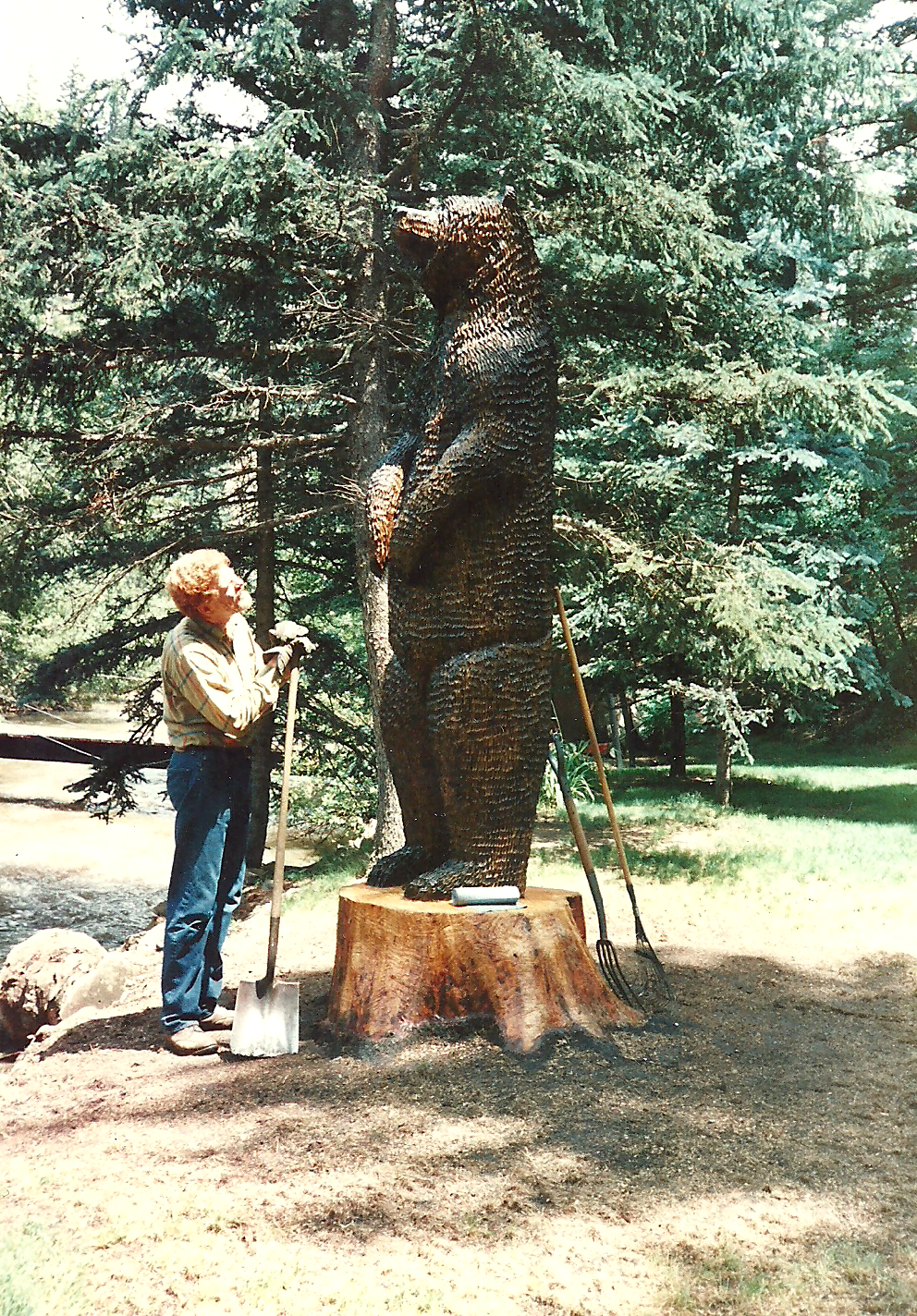
I respectfully stand in awe at the talent of the wood sculptors. They are dealing with quite a different commodity than clay, marble, bronze, or steel. Don Rutledge, the artist we had commissioned to sculpt the 12-foot tall grizzly bear and the 6-foot tall cub, had to be extremely mindful of the temperament of the wood.
 
Since the wood was still “green” and still attached to the 450 year old roots in the ground, he had to continuously spray the sculpture with water so that it did not dry out unevenly and crack in Colorado’s low humidity and high elevation. In fact, each night, Don wrapped the bears in wet packing blankets to keep them evenly moist. I was made mindful of the many times God had wrapped me in his packing blankets of mercy and grace while I was being chopped.

I stand I awe of the talent of the artist, but my amazement is in regard to the chain saw. That’s a mean machine! Don never touched the wood one time with a chisel and hammer. He performed every requirement with the gas powered chain saw, even to the carving of the “fur.”

While I watched the sculpting process I could not help but think of the obvious life lesson involved. “With the roughest of tools can be sculpted a thing of beauty.” I have watched the remarkable talents of those who sculpt marble in Italy, Romania, Africa, and especially in Vietnam. I can sometimes identify myself with the marble as the sculptors of real life have chiseled the rough edges from the slab of my own identity. I have experienced that the process of being shaped and chipped and hammered is not pleasant, at best, but painful and hurtful. But the crude harshness of a chain saw is pretty radical. And yet, I can tell you of times when I could swear that it was definitely a chain saw at work on my attitudes, hopes, and behaviors. It wasn’t a “peck, peck, tap, tap . . . it was varooooom, varoooom!” And the only retort I could come up with was an infantile, “would you at least sharpen the chain?” But even with the roughest of tools can be sculpted a thing of beauty.

I recall from one of my favorite authors, Oswald Chambers, who wrote, “The things we are going through are either making us sweeter, better, nobler men and women, or they are making us more captious and fault finding, more insistent on our own way. The things that happen either make us fiends, or they make us saints; it depends entirely upon the relationship we are in to God.”

LESSON #4: Addition vs. Subtraction.


All the time Don was sculpting the two bears he never went out and brought something back to the creek site to add to the project. He never screwed on something over here or nailed on something over there.

I watched with curiosity. The only function utilized by the artist was to systematically pare away the parts of the tree that were unnecessary. He had told me at the beginning, “I see a bear in that tree and I have to help him come out.” The only pieces of the tree that were cut away were the pieces that were restraining the magnificent bear from coming out.

It is not necessarily what we add, but sometimes what we subtract, that brings about perfection and beauty. For example, we usually think happiness will be achieved by adding something to our lives. We say, “I would be happy if . . . I had a different house . . . a new job that paid more money . . . I could win the lottery . . . had a new husband . . . .” I had a friend that once told me, “I believe that happiness is determined by the things we have successfully learned to live without.”

Perhaps God does not want you to learn something from the situation in which you find yourself today. Just maybe . . . he wants you to unlearn something. Anyone can become complicated, but it takes real wisdom to become simple. “Simple” includes paring away the unnecessary, the distractions, the addictions, and the impediments that would keep us from becoming the resplendent individuals of beauty and usefulness for which we were imagined and designed.

I’m extremely pleased that we had Don Rutledge transform our spruce tree. I’m even more pleased that I was able to be an observer and learn the “Lessons from the Bears.”


Dr. James W. Jackson often describes himself as "The Happiest Man in the World." A successful businessman, award-winning author and humanitarian, Jackson is also a renowned Cultural Economist and international consultant, helping organizations and governments to apply sound economic principals to the transformation of culture so that everyone is "better off."

As the founder of Project C.U.R.E., Dr. Jackson traveled to more than one hundred fifty countries assessing healthcare facilities, meeting with government leaders and "delivering health and hope" in the form of medical supplies and equipment to the world's most needy people. Literally thousands of people are alive today as a direct result of the tireless efforts of Project C.U.R.E.'s staff, volunteers and Dr. Jackson. 

To contact Dr. Jackson, or to book him for an interview or speaking engagement: press@winstoncrown.com