Showing posts with label china. Show all posts

Tuesday, March 22, 2016

MORE EXCITING NEWS: Looking Forward to the New Book Better Off: How America Got Wealthy & You Can Too!

Founder, Project C.U.R.E.
Author, The Happiest Man in the World: Life Lessons from a Cultural Economist


We talked last time about why some countries are wealthy and some countries wallow in misery and poverty. On page 20 of the new Better Off book I use a couple of real-life examples.

A Tale of Two Countries

In the early 1980s, I embarked on one of my first international economic assignments in Zimbabwe, Africa. I was there at the invitation of prime minister Robert Mugabe—who later became president—and members of his cabinet. It didn’t take long to realize that Zimbabwe wasn’t the place for me. Civil war had not only claimed thousands of lives, but the government had also imposed a policy of forced redistribution of assets and property. However, I was there long enough to become well acquainted with the political and economic situation.

Formerly known as Rhodesia, the “bread basket of Africa,” Zimbabwe has a population of more than thirteen million people and boasts some of the richest farmland on the face of the earth. The country also has one of the finest railroad systems in all of Africa, as well as the world’s largest platinum reserves. In the past century, the Marange diamond fields were one of the greatest discoveries, but Zimbabwe is most famous for the great Zambezi River that flows over the majestic Victoria Falls.

Zimbabwe has everything imaginable to qualify it as one of the wealthiest countries in the world. But today it wallows in poverty. According to the Mundi index of gross domestic product (GDP), as of January 1, 2014, the per-capita earnings of the people of Zimbabwe amounted to just $600 per year. That’s $1.64 per day! Out of 228 countries, Zimbabwe ranks 227!1 Why?

Next, let’s consider a little spot on the globe called Hong Kong. More than seven million people inhabit this 400-plus-square-mile parcel of land bordering the South China Sea. Most residents emigrated to Hong Kong from Guangdong Province in China to escape conflict. In 1997, Great Britain returned Hong Kong to the People’s Republic of China, and it has remained under Chinese rule ever since.

Hong Kong possesses very little arable land and almost no natural resources, except for a shoreline sufficient for a port. As of 2013, the Hong Kong dollar was the thirteenth most traded currency in the world.2 The tiny administrative region has become one of the most important financial centers in the world, following New York and London,3 and is considered the epicenter for management, finance, Internet technology (IT), business consultation, and professional services.

Hong Kong has a well-developed transportation system and is lauded for the exquisite quality of life its residents enjoy. In fact, life expectancy in Hong Kong is one of the highest in the world—eighty years for men and eighty-five for women.4

Year after year, the Heritage Foundation’s Index of Economic Freedom has listed Hong Kong as the freest market economy in the world.5 The Mundi index of per-capita income ranks Hong Kong sixteenth in the world, with individual earnings at nearly $53,000 per year.6 That’s $145 per day, or approximately 90 percent more than the folks in Zimbabwe earn in a year.

Hong Kong doesn’t possess even a fraction of the natural and human resources available to Zimbabwe, and yet it’s one of the wealthiest regions on earth. Why?

The hunt for clues continues!

© Dr. James W. Jackson   
Permissions granted by Winston-Crown Publishing House


Dr. James W. Jackson often describes himself as "The Happiest Man in the World." A successful businessman, award-winning author and humanitarian, Jackson is also a renowned Cultural Economist and international consultant, helping organizations and governments to apply sound economic principals to the transformation of culture so that everyone is "better off."

As the founder of Project C.U.R.E., Dr. Jackson traveled to more than one hundred fifty countries assessing healthcare facilities, meeting with government leaders and "delivering health and hope" in the form of medical supplies and equipment to the world's most needy people. Literally thousands of people are alive today as a direct result of the tireless efforts of Project C.U.R.E.'s staff, volunteers and Dr. Jackson. 

To contact Dr. Jackson, or to book him for an interview or speaking engagement: press@winstoncrown.com

Tuesday, June 10, 2014

AT THE INTERSECTION: EXAMPLES FOR THE MATRIX

Founder, Project C.U.R.E.
Author, The Happiest Man in the World: Life Lessons from a Cultural Economist


We have now discussed the components of economic production: Land, Labor, Capital, and the Entrepreneur, and also the components of our cultural structure: Traditions, Institutions, Family, and the Individual. Our premise is that Transformation takes place at the intersection of Culture and Economics. Wherever the components of Culture and the components of Economics cross in the intersection of real life, you can expect change.

I’m going to resort to the chalk board and see if we can walk through some common examples in order to see just how such a thing works. The components of Economics will be positioned along the left side of our matrix and the components of Culture will follow the bottom line. The dynamics of the situational example will determine the point of intersection and which of the components will be involved in the confrontation that sets up the incidence of transformation:
  • We talked earlier about the incredible global transformation that took place based on the intuition and action of Alexander the Great after being influenced by the cultural and economic insights of his personal teacher, Aristotle. He conquered the known world.
  • Two hundred seventy- one years later, Julius Caesar laid claim to Alexander’s dream and once again, transformed the global system at the intersection of culture and economics.
  • King James of England, in 1606, granted rights to a business investment company to establish the first American colony in an area designated as Virginia. But the second contract was made with another organization to establish a colony in America. That contract was born out of conflict and the desire for change and freedom. The Pilgrims were a group of settlers who had previously left England to seek relief and freedom in Holland. Disappointed there, they found investors willing to underwrite the expenses of a contract to colonize in America. On September 16, 1620, the Pilgrims set sail on the Mayflower and landed sixty-five days later. At the intersection of culture and economics, the Pilgrims employed their powerful traditions and even religious institutions and families. They set into motion transformation in areas of land use, labor, and capital and the individuals eventually realized the fruits of a new world
  • Eventually the American Revolutionary War between young America and England would be fought at the intersection of culture and economics. Institutions, traditions, families and individuals were pitted against each other on matters of land, labor, capital, and entrepreneurial enterprises.
  • Within recent years, China’s citizens have experienced immeasurable transformation due to national laws implemented in 1979 limiting the family’s size to one child per couple. I personally visited many orphanages throughout China and have been acquainted with the affects of the policy that was fully centered at the intersection of culture and economics. The policies were initiated to alleviate social, economic and environmental problems in China, but have set into motion firestorms of consequences.

  • A bit closer to home . . . we commonly experience the intersection phenomenon in controversial land use situations. Traditions endeavor to dictate how a certain piece of property will be used regardless of personal or institutional ownership rights. Or, a municipality may want to appropriate or condemn a property and build a big box store or commercial strip in order to generate higher tax revenues. The battle is waged at the intersection of culture and economics.
  • Divorce settlements, civil suits, and estate squabbles so very frequently find the principles yelling at each other in the middle of the intersection of culture and economics.
  • Individual families, also, find themselves hammering out philosophical differences at the intersection when it comes to making decisions regarding how they will earn and spend their resources.
  • Don’t be surprised when it dawns on you that this same matrix works even for such issues as dealing with the disciplining of the children, (Land = Resources, Labor = Activities, Capital = Rights and Rewards, Entrepreneur = Creativity and Independence). We can count on major transformation taking place at the intersection of culture and economics even when applied to the components involved in domestic situations.

We live in a world of transformation. It is good for us to concern ourselves with how we can more efficiently allocate and manage our resources and abilities. It is also to our benefit to discover and understand how various aspects of human cultures interact with economic events, behaviors, and conditions. Economic philosophies and systems have the power to affect and shape our culture, as well as our culture having influence on our political systems, inherited traditions, religious beliefs and the formation of our institutions. It is imperative to lay aside the notion that economic has only to do with money. It is also imperative to more fully comprehend the scope and sequence of culture.

As we move into a more complete understanding of the eight components listed herein, and see how they work together under a larger umbrella of cultural economics, our identification of problems and even our tasks of conflict resolution will be more easily accomplished.

Next Week: Our Market Basket

(Research Ideas from Dr. Jackson’s new writing project on Cultural Economics) 

© Dr. James W. Jackson  
Permissions granted by Winston-Crown Publishing House

www.drjameswjackson.com  

Dr. James W. Jackson often describes himself as "The Happiest Man in the World." A successful businessman, award-winning author and humanitarian, Jackson is also a renowned Cultural Economist and international consultant, helping organizations and governments to apply sound economic principals to the transformation of culture so that everyone is "better off."

As the founder of Project C.U.R.E., Dr. Jackson traveled to more than one hundred fifty countries assessing healthcare facilities, meeting with government leaders and "delivering health and hope" in the form of medical supplies and equipment to the world's most needy people. Literally thousands of people are alive today as a direct result of the tireless efforts of Project C.U.R.E.'s staff, volunteers and Dr. Jackson. 

To contact Dr. Jackson, or to book him for an interview or speaking engagement: press@winstoncrown.com

Tuesday, July 9, 2013

NOT JUST BEST, BUT LEGENDARY

Founder, Project C.U.R.E.
Author, The Happiest Man in the World: Life Lessons from a Cultural Economist


I knew I was in trouble. There was no domestic air service from the Chinese city of Shaoyang to Zhengzhou. I would have to take an area transport bus for four hours to a city called Changsha. There I could catch a train to Zhengzhou for my next hospital assessment.

Traveling in northern China was not easy. As soon as the Chinese people began to work their way out from under the restrictive and oppressive restraints of the government, and began to once again exercise their natural DNA talents for business and enterprise, the nation as a whole began to awaken like an aroused giant. Such things as transportation systems were still trying to catch up with the new demands.

I successfully boarded the old rickety bus headed for Changsha, but mechanical problems with the bus had us stopping periodically to refill the leaky radiator. We were losing precious time, and I could see that it was going to be a close call for me to get to the train depot before my train left for Zhengzhou. As our driver approached the outskirts of Changsha, we encountered a stand-still traffic jam.

I explained again to my young translator just how important it was that I not miss the train to Zhengzhou. When we realized that the bus could never possibly get us to the station on time, we agreed on a risky and creative option. We asked the bus driver to open the door and let us out. We scrambled out with my luggage and ran across the road to the lane of traffic that was traveling away from the city. It was not deadlocked. Within two minutes I was able to hail a local taxi. My translator explained our urgency to get to the train depot immediately. The driver was a young, aggressive man who liked the looks of the U.S. dollars I was holding in my hand. He took the next side road and we were off like the down of the thistle in a wind storm.

The little taxi came sliding to a stop at a side entrance to the train depot with dust bellowing around us. I graciously paid the aggressive driver, and my translator and I went running down the platform to coach number fifteen in spite of all the train attendants waving their arms at us. The door on our coach was still open and I tossed my luggage up into the coach as the conductor began blowing his whistle to start the train rolling. Our goofy gamble had paid off and we had made it!

The train coaches were completely packed, but eventually we were able to find a place where we could hunker down for the balance of the fourteen-hour trip to Zhengzhou. Upon arrival we located a small, clean hotel room where I was able to sleep a couple of hours and take a refreshing shower. I was ready to visit the next two hospitals.

Zhengzhou is located in the province of Henan that claimed a population of over 100 million people. Our first hospital to assess was the Zhengzhou Affiliated Hospital, a one thousand bed hospital that was involved in some very extensive remodeling. Our second hospital to assess became the delight of my entire trip.

As we walked through the front doors of the Zhengzhou 5th People’s Hospital, we were met by three young, attractive Chinese ladies in white, crisply starched nurse’s uniforms and caps. Across the front of each uniform was neatly draped a bright red satin sash with gold writing. One of the nurses approached us with a beautiful smile and kindly asked us how she could assist us? My translator told her we were there for an appointment with Dr. Rang Da Zhong, the Hospital Director.

The young lady informed us that the director was anticipating us and to follow her. The other two ladies stayed near the door in the front lobby. As we followed our hostess I, couldn’t help but notice that the hallways, the lobbies, and even the elevators were bright and shining clean. As we passed through the Ophthalmology department, I mumbled that we just as well could have been walking down the halls of an eye clinic anywhere in Chicago or Los Angeles. The new equipment was state-of-the-art and the facilities were attractive in every way. I later found out that their eye surgeons had been trained abroad and they were already using their laser and microscopic surgery machines to their fullest.

Dr. Zhong was a personable fellow and genuinely glad that we had come. He was not only the director, but was also one of the chief surgeons. He was an interesting combination of pleasing personality, high energy, and dignity. Following a couple of minutes of introduction we got into the process of the questions of the assessment. In addition to walking the halls of the facility and visiting every department, I asked if I could dress down in scrubs and observe the equipment and procedures going on in the operating theaters. The director was gracious in every respect.
When finished, I was welcomed back into the conference room where I met the president and vice president of the hospital. They shared with me briefly about their plans for new construction, then frankly asked me for my input and observations about their hospital and how they could make it better.

I told them that I had walked the halls of thousands of hospitals in developing countries around the world but their hospital was different from any other. From the greeting I had received in the lobby to the observations in the surgery theaters there was a sense that everything was under control, everyone there was happy to be there doing what they were doing and they were all headed in the same direction philosophically and administratively. I told them, “No organization will rise above its leadership. What I have observed today is that the success of your institution has started with you the leaders. In my opinion, you are the greatest example of entrepreneurial, capital-intensive marketing that I have seen in a developing country. You are effectively leading. Keep at it!”

They sat there stunned for a minute and then replied, “How could you see so much by just briefly walking through our hospital? We want to take you to lunch.” There we continued to talk about China, economics, and the healthcare industry. At one point I asked them to tell me what had happened at their hospital that had made them so different.

They looked at one another and then began telling me the story. A man by the name of Sam Walton had come to China to open up some super markets. The people from Zhengzhou 5th People’s Hospital had all gone to the Sam Walton School. They showed me what they had learned:

Rule 1: Commit to your business. Believe in it more than anybody else and pretty soon everybody around will catch the passion from you — like a fever.
Rule 2: Share your profits with all your associates, and treat them as partners.
Rule 3: Constantly, day by day, think of new and more interesting ways to motivate and challenge your partners. Set high goals, encourage competition, and then keep score.
Rule 4: Communicate everything you possibly can to your partners. Information is power, and the gain you get from empowering your associates more than offsets the risk of informing your competitors.
Rule 5: Appreciate everything your associates do for the business; all of us like to be told how much somebody appreciates what we do for them.
Rule 6: Celebrate your success. Find some humor in your failures. Don't take yourself so seriously. Have fun. Show enthusiasm — always.
Rule 7: Listen to everyone in your company and figure out ways to get them talking.
Rule 8: Exceed your customers’ expectations. If you do, they'll come back over and over. Give them what they want — and a little more. Let them know you appreciate them. Make good on all your mistakes, and don't make excuses — apologize.
Rule 9: Control your expenses better than your competition. This is where you can always find the competitive advantage.
Rule 10: Swim upstream. Go the other way. Ignore the conventional wisdom.

“Dr. Jackson, the government in China has stopped giving free medical service. We think that’s good for us. Now we need to figure how to finance the system because everyone still needs medical help at some time. We have decided that there will be enough money available to support our hospital, and if we are in competition with other hospitals for the money that is available then we will make the people want to come to our facility and buy our medical service from us. Sam Walton says that people want a good shopping experience. We will give the people the best medical experience. If they want good parking we will make good parking available.

“We will give the people friendly service from happy and helpful people. We will give to them clean and attractive facilities and the best and most modern equipment. But Sam Walton says most of all we must train our people to have teamwork and always attain excellence in everything. We must have goals and become the best. Dr. Jackson, if there is money in Zhengzhou for medical services, then we are going to capture that money for our hospital. We think people will find the money if we will give them good and happy results. When we receive the money we can continue to buy the best equipment and give even more excellent service. We don’t want to be just the best, we want to be legendary.” 


Dr. James W. Jackson often describes himself as "The Happiest Man in the World." A successful businessman, award-winning author and humanitarian, Jackson is also a renowned Cultural Economist and international consultant, helping organizations and governments to apply sound economic principals to the transformation of culture so that everyone is "better off."

As the founder of Project C.U.R.E., Dr. Jackson traveled to more than one hundred fifty countries assessing healthcare facilities, meeting with government leaders and "delivering health and hope" in the form of medical supplies and equipment to the world's most needy people. Literally thousands of people are alive today as a direct result of the tireless efforts of Project C.U.R.E.'s staff, volunteers and Dr. Jackson. 

To contact Dr. Jackson, or to book him for an interview or speaking engagement: press@winstoncrown.com

Tuesday, January 24, 2012

The Sun Was Shining in Beijing

Founder, Project C.U.R.E.
Author, The Happiest Man in the World: Life Lessons from a Cultural Economist


“Man who says it can’t be done should not interrupt man doing it.”


Project C.U.R.E.’s first donations of medical equipment and supplies had entered China in 1989, and even though Project C.U.R.E. wanted to cooperate and send even more medical goods into China, the government had introduced new restrictions that blocked our efforts. China did not have any law or written policies regarding outside humanitarian groups wanting to enter their country. They simply said, “No.”

Traveling with me on my trip from Denver to Beijing was Joshua Zhong, founder of Chinese Children Adoption International and a native of Fushun, China. He had made contact with a very high government official in Beijing, named Yan Ming Fu. Mr. Yan had recently been appointed to Minister of Civil Affairs and head of China Charity Federation. Everyone had advised me that our attempt to travel to Beijing and receive any concessions would be absolutely futile. No one was receiving permission to work in China.

The Federation had been established in 1994 with the sole purpose of being in total control of all humanitarian efforts throughout the country. They were in charge of all disaster relief, social relief, poverty issues and any other charitable functions. If Project C.U.R.E. would ever hope to find favor within China for their humanitarian work, that favor would have to come through that one man. I realized that all of Project C.U.R.E.’s involvement in China in the future was dependent on finding a way to be accepted by the Federation and given special favor and recognition.

Friday morning was very cold and stormy in Beijing. Our small taxi took us through the rain to a large government office building not too far from Tiananmen Square and “Forbidden City,” where we were to meet with Mr. Yan. I felt the excitement of the occasion as I walked into the room. This meeting would determine Project C.U.R.E.’s effectiveness, or even existence, in China. The time had come.

I thanked the officials deeply for the meeting and began to share with them about Project C.U.R.E. and our work around the world. I told them that I had visited many of the Chinese hospitals and had performed “Needs Assessment Studies.” I showed Mr. Yan many pictures of their own needy hospitals. I had seen their healthcare system with my own eyes. Mr. Yan jumped right in and began asking me many questions. I showed him pictures of our warehouses and volunteers in the United States. Finally, I felt the time was right and went for the main point.

“Mr. Yan, I have fallen in love with your country and your people, and I want to be a friend and come along side you. But it is too difficult to work with you. Everyone has told me that I am foolish to come directly to you, but I sincerely want to help. The problem is that your system does not allow me to be successful. I cannot ship my donations into China like I can the other nearly 100 countries around the world. That makes me very sad. So, I have come all the way to Beijing to ask you to help me.”

Mr. Yan looked at me and with a quick wink said, “So, they tell you that you are foolish to come and talk to me directly because I will say, ‘No’. Well, in our country we have an old Chinese proverb, ‘Man who says it can’t be done should not interrupt man who is doing it!’”

“Who has given you the trouble?” Mr. Yan rumbled, “Because you and I are going to work together in China for a long time in the future.” “I don’t believe that it is any ‘person’,” I answered, “it is just that your laws do not allow for it. I need your help to guide me around that problem,”

“Well,” Mr. Yan said emphatically, “you have come to the right place. I am the right man to help you. From this day forward you will not again have a problem getting any of your shipments or programs into China, and they will be tax-exempted. I will see to it personally. As you have shown me, our big city hospitals are functioning quite well, but our smaller hospitals and our rural areas in China need everything. We must work together for a long time. Dr. Jackson, do you want to sign an agreement to guarantee your status?”


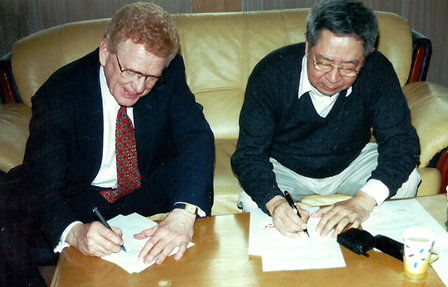
“Yes,” I answered emphatically, “I would like that!” I was astounded at the complete acceptance. When the proper paperwork was completed, Mr. Yan entered the room again and came to the table and sat down beside me. He took out his pen and we both signed the agreements as the flashing lights from the cameras lighted up the room. It was done. Everything I could have hoped for was on an official document and signed by one of the most influential men in all China. I stepped outside the big gray concrete government building. The rain had stopped and the sun was shining in Beijing.


Dr. James W. Jackson often describes himself as "The Happiest Man in the World." A successful businessman, award-winning author and humanitarian, Jackson is also a renowned Cultural Economist and international consultant, helping organizations and governments to apply sound economic principals to the transformation of culture so that everyone is "better off."

As the founder of Project C.U.R.E., Dr. Jackson traveled to more than one hundred fifty countries assessing healthcare facilities, meeting with government leaders and "delivering health and hope" in the form of medical supplies and equipment to the world's most needy people. Literally thousands of people are alive today as a direct result of the tireless efforts of Project C.U.R.E.'s staff, volunteers and Dr. Jackson. 

To contact Dr. Jackson, or to book him for an interview or speaking engagement: press@winstoncrown.com